Inside the Web3 Customer Mind – Design for Ego, not Wallets


Financial gains are not the only motivation for people to enter Web3.
Yes, the majority starts there — and according to a recent “State of Onchain UX” report by Reown and Nansen, it remains the primary motivation for 46% of participants. But there’s something else that keeps them in this up-and-down space, with its never-ending stream of bold promises.
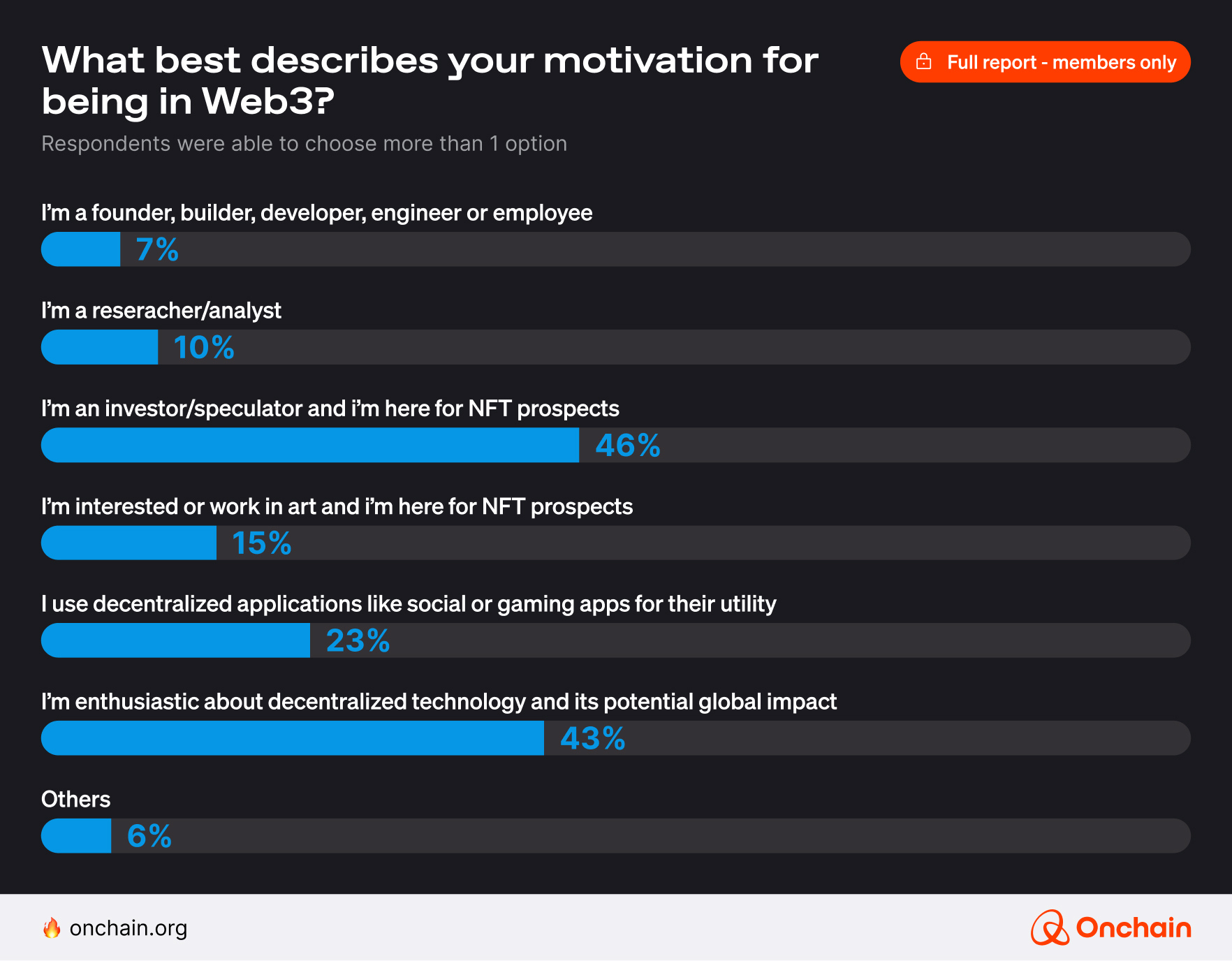
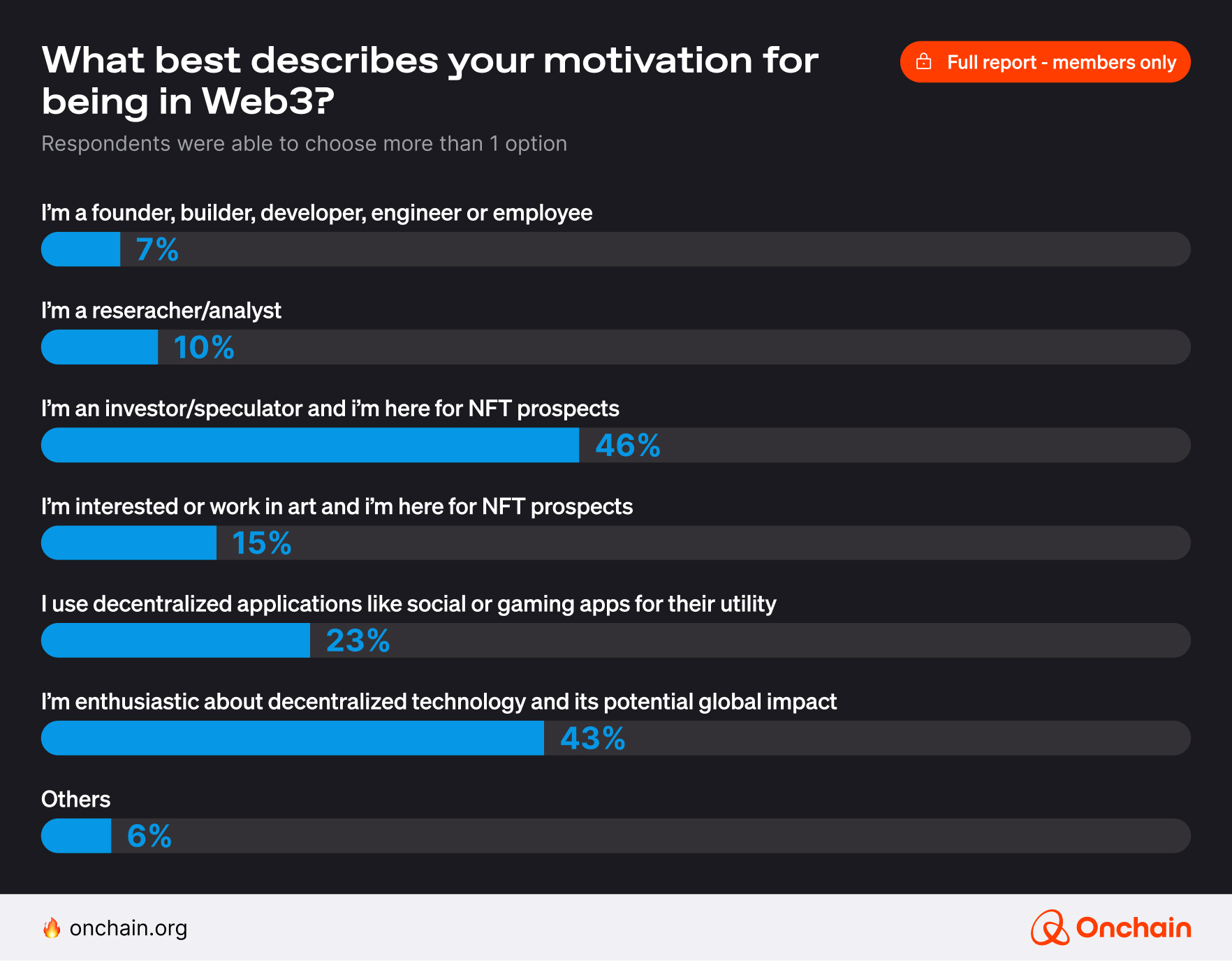
Some call it culture. Others stop at “cult.” And yet another group explains it by forcing meaning into something purely economic. Whatever that is, it leads from “owning digital assets” to a new kind of identity construction:
- People go beyond only buying tokens and start adopting beliefs.
- They don’t just interact with networks, but begin to play roles within tribes.
- They shape – and are shaped by the onchain experience.
This report helps you understand this subtle, sometimes uncanny psychology of the Web3 user. But rather than listing preferences or flat personas, it provides a set of insights, tools, and frameworks so you can explore the psychography of your Web3 customer, not just “a Web3 customer”.
That’s why I structured this piece as follows:
Part I explores the psychological foundations of Web3 participation, examining how people think, behave, and evolve once they “go onchain.”
Part II turns those insights into action, offering founders a practical toolkit to understand, segment, and tailor their offering to their users’ minds.
Part I: How Web3 Consumers Think
The onchain identity pyramid
First things first, Web3 users simply cannot be generalized. Even if they are all connected by the desire to “get rich quick,” the path to achieve this depends on various factors. These include their financial situation, tolerance for risk, cultural habits, and many other aspects that influence their non-economic decisions as well.
But if you zoom out a bit, a few psychological patterns emerge. And they are often “sticky” enough to shape how people behave, believe, and build onchain.
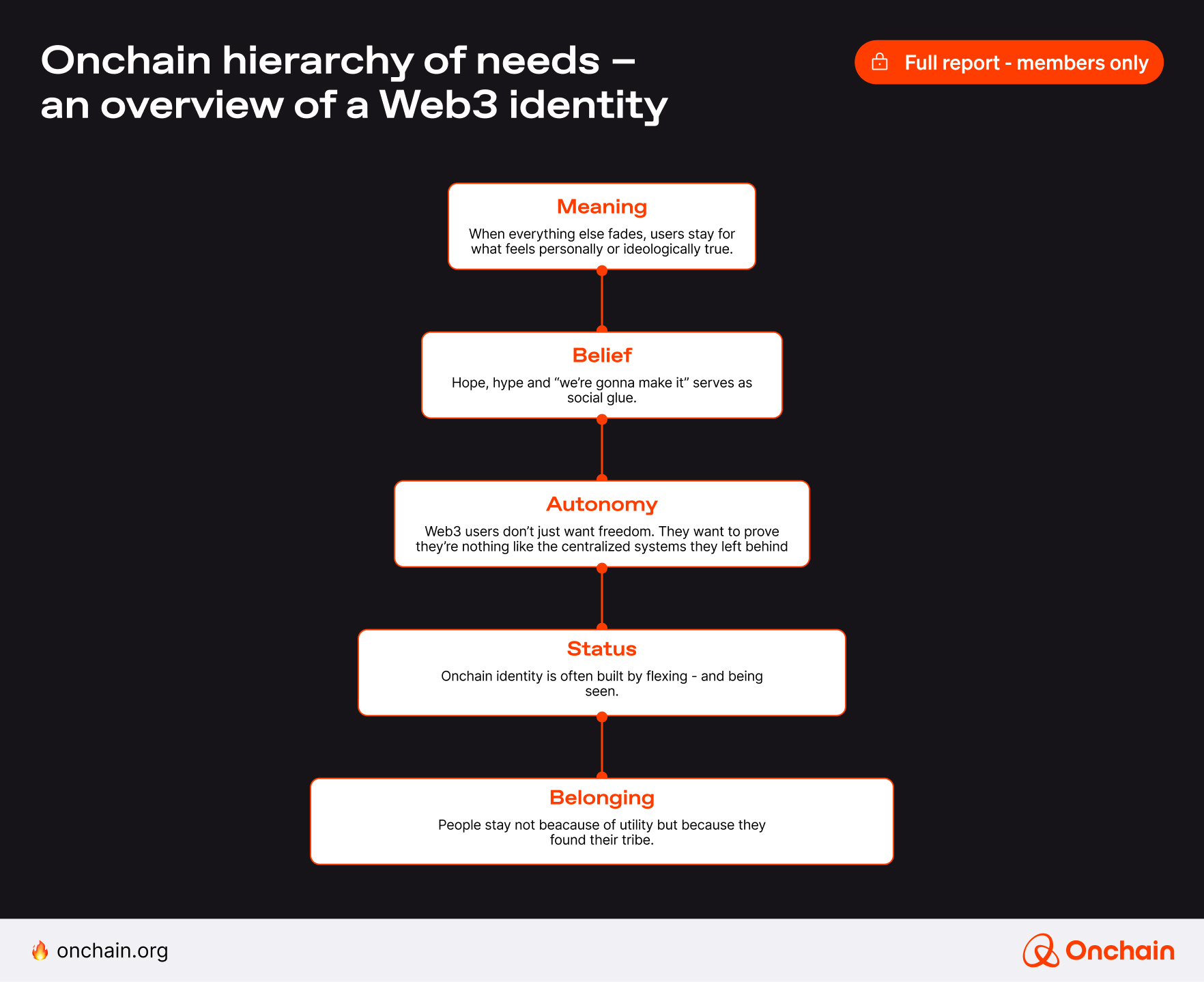
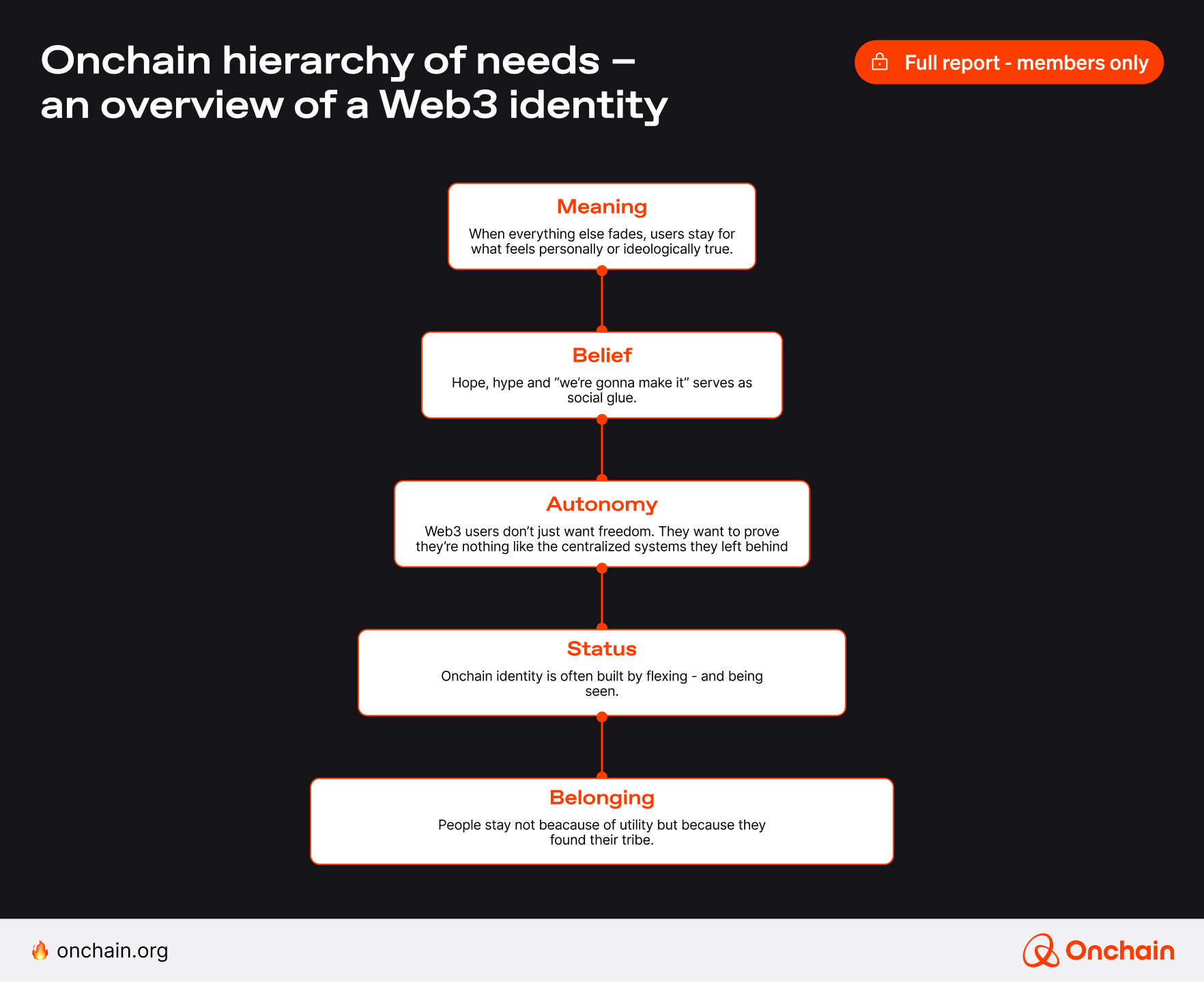
We’ve seen these patterns play out across ecosystems, user interviews, onchain behavior, and our own research at Onchain. You can think of them as components of an Onchain hierarchy of needs – a loose but useful way to understand what makes a crypto user feel like one.
1. Belonging
At the basis of Web3 identity lies the social glue. As our article From Tribalism to Loyalty explains, Web3 tribes are more than Discord servers with a token attached. They are arenas for identity rehearsal, social mirroring, and eventual alignment.
💡 But, aren’t Web3 communities just “digital groups of people who like to make money together”? Of course, the majority serve precisely this purpose. However, research shows that people are more likely to stay within communities that are specifically formed through economic transactions. So, the secret sauce of Web3 tribes is now confirmed by data.
2. Status
The first building block on the foundation of belonging is status. The Web3 world runs on social signaling. From NFT flexes to Lambo pics, people continuously construct narratives about who they are – and what they’ve done onchain (or thanks to onchain).
Psychologically, this taps into self-enhancement motives: The need to feel competent, unique, or achieve a high status within a group. But it also reinforces behavior. Public onchain footprints (and completely offchain ones – i.e., crypto Twitter postings) create subtle performance pressure, nudging users to act in ways that maintain or enhance their perceived identity.
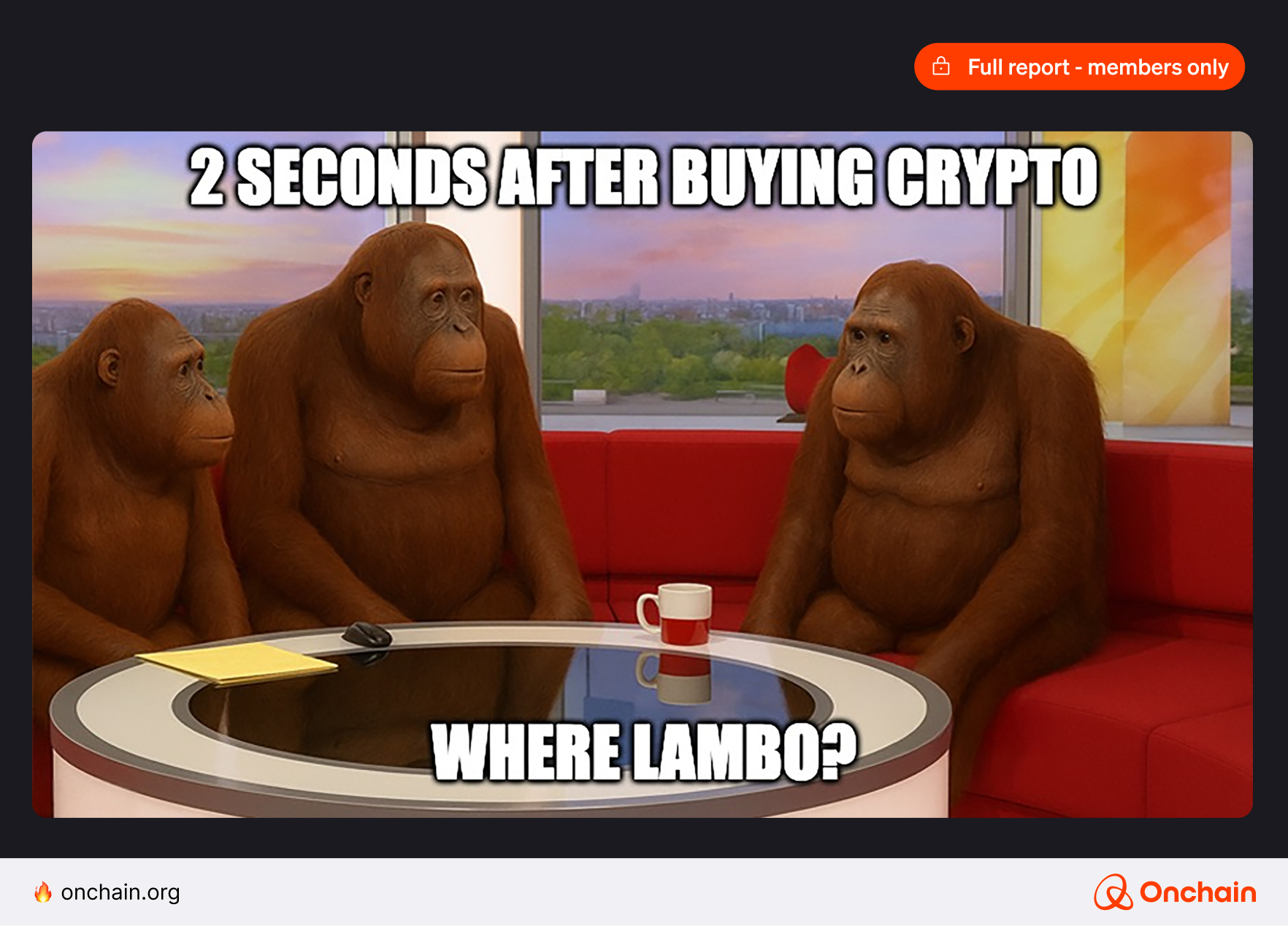
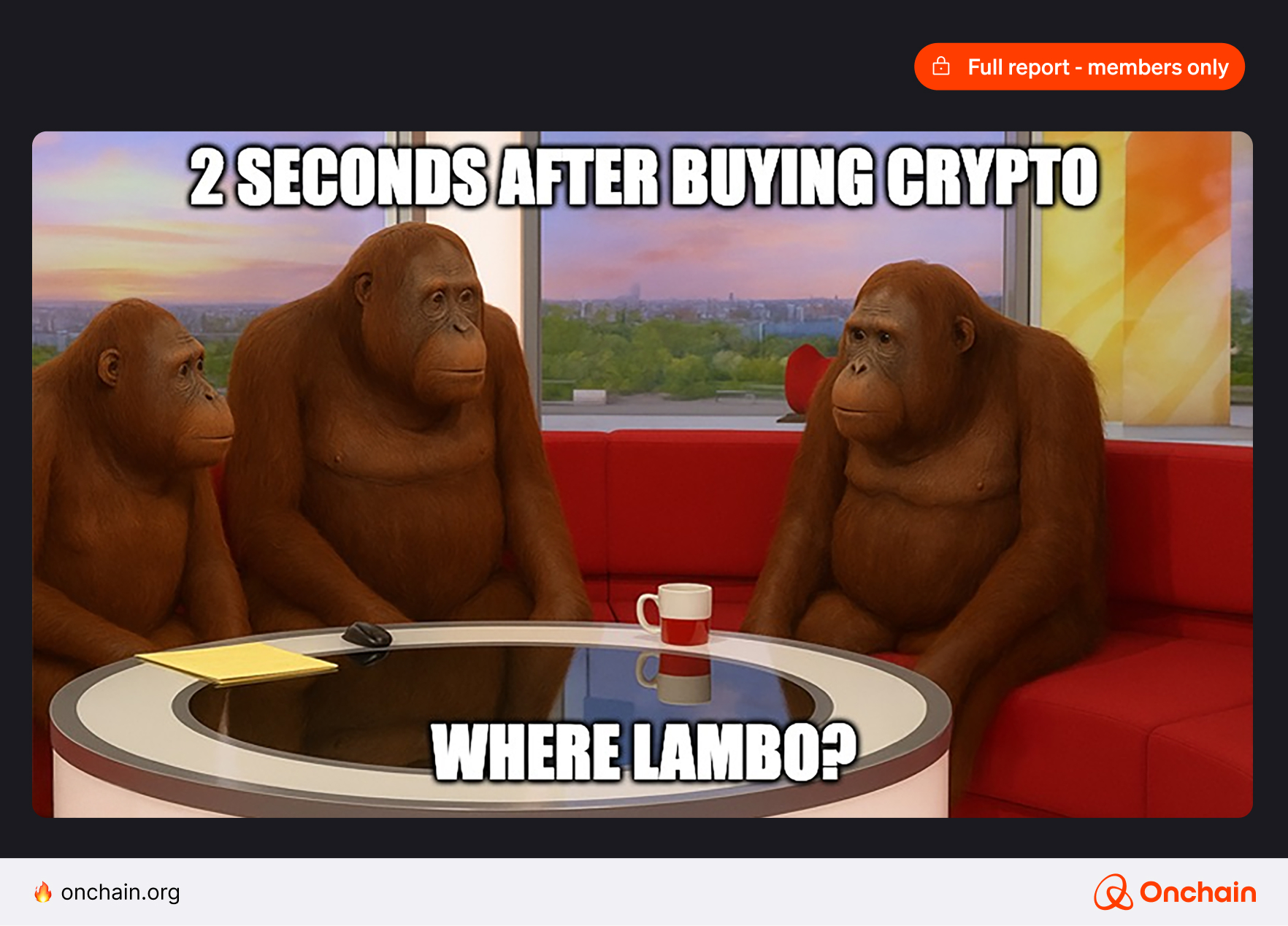
💡 So, dear founders, design products that let users adapt and flex. You’ll basically create systems that reward identity reinforcement and turn visibility into loyalty. Kaito has created a blueprint for it.
3. Autonomy (or manifesting the difference)
Web3 attracts those who want to operate on their own terms. Sometimes, they frame it as a matter of sovereignty. And sometimes, it’s just about being “not like them.”
This is rooted in the origins of the space itself. Bitcoin was introduced with the explicit mission to establish a financial system independent of banks and the state. Over the years, the Web3 movement has taken it to another level, striving to differentiate itself from others. As I said in my article in the Onchain Magazine:
(…) Many Web3 groups are shaped just as much by shared identity and outsider energy: the feeling of being different, underestimated, or misaligned with mainstream systems.
💡 A BUIDLing advice? Give people a way to use your product to demonstrate they’re different. Suppose you weren’t planning to introduce an NFT collection with quirky PFPs into your technologically advanced Web3 masterpiece. In that case, it might be the stickiest tactic you can ever pursue in this space.
4. Belief
Generational wealth is the next level in the psychological hierarchy. “We are all here for that, aren’t we?”
A strong belief in the need and ability to bring about life changes through crypto is usually the starting point for a Web3 journey. To stay strong in the space, shouting “we are gonna make it” and repeatedly reassuring (or seeking reassurance) are critical, especially during tough phases. As you can see below, the desire to comfort oneself seems never-ending:
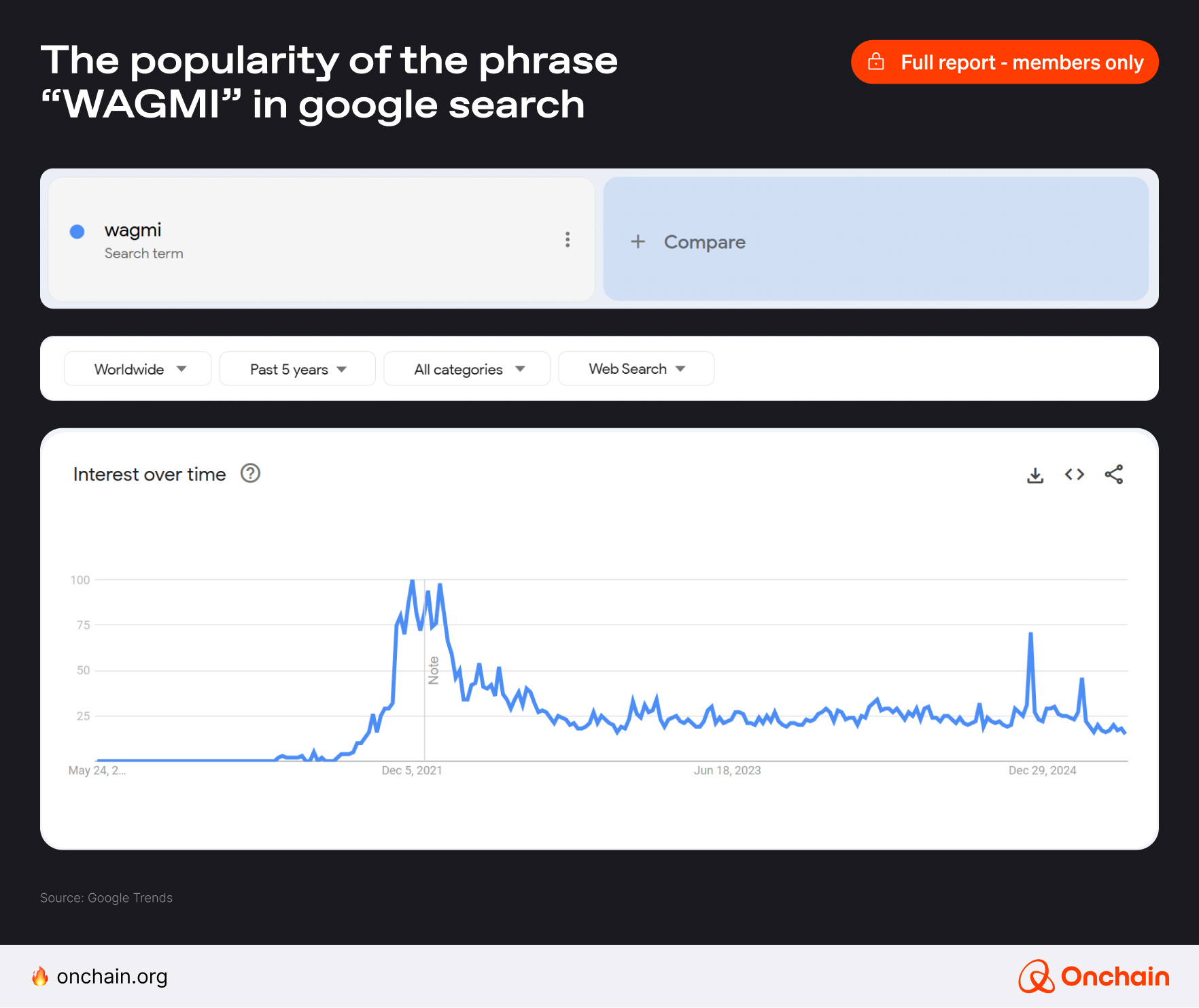
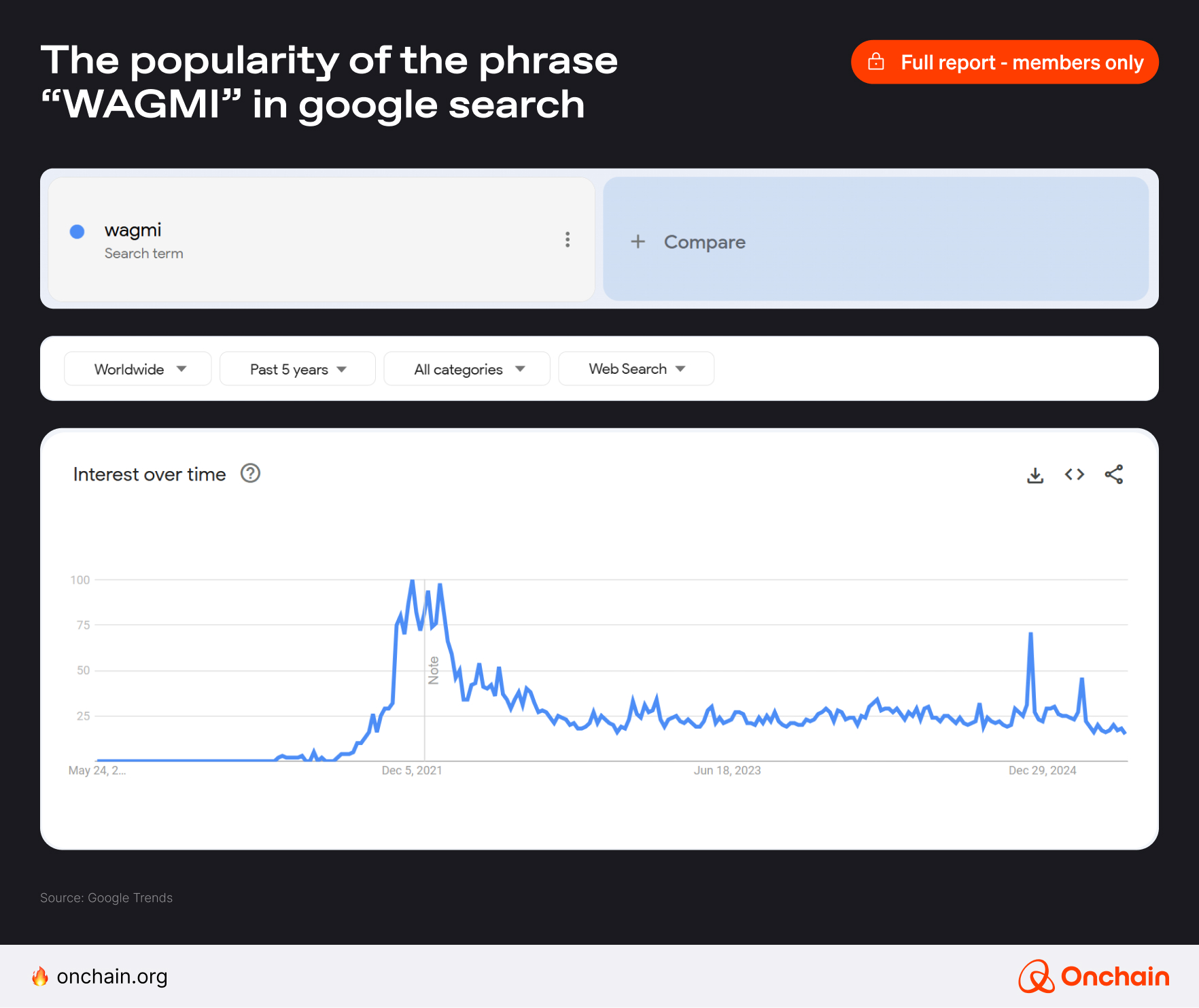
Then, why do I place this close to the top and not at the foundation of our Onchain Identity Pyramid? Because after some time, the numbers don’t matter anymore, especially for hardcore degens. Seeking generational wealth is replaced by “lifestyle trading”, where gains and losses serve as a means to address dopamine needs.
💡 Our research confirms this assessment. According to a study conducted among 2000 crypto owners in the UK and US, over 1 in 5 are defined as pure “thrill seekers” for whom Web3 is primarily about the fun and excitement of seeing profits.
5. Meaning
Lastly, once all the other needs are at least partially satisfied, the Web3 folk might finally focus on real meaning. It rarely comes first. Be honest, wasn’t the initial spark that drove you a quick gain, status, or belonging? I thought so.
Ironically, it aligns well with the top of the original Maslow’s hierarchy (self-actualization) and with classic psychological models like Self-Determination Theory, where intrinsic motivation (doing something because it feels aligned with your values) becomes more important over time.
💡 Hence, your beautiful mission is important. But it won’t matter much unless you address the customer’s need to see the potential upside: improving personal status or belonging to a broader group of crypto insiders who recognized the opportunity early. Think about it whenever you decide on whether to prioritize product development or creating a video pitch for X.
—
These 5 elements together sketch the psychological profile of those who self-identify as being onchain, rather than merely transacting. Once the identity is activated, the behavior follows its own logic.
However, human behavior is rarely rational. When accompanied by intense emotions, the risk of losing money, and the ubiquitous allure of Web3, it becomes riddled with shortcuts and cognitive biases.
That’s what I will explore next.
Predictably irrational: Cognitive biases in Web3
Let me put on an academic or nerd (choose one or both) hat for a second. I wrote a PhD about cognitive biases in the digital world and the ways to address them. So, this chapter could likely become a new thesis.
As I unpack the core elements of onchain identity – i.e., who Web3 users would want to be – I also need to understand how they actually behave. It’s rarely the same. Fortunately or not, we’re homo sapiens, and not homo oeconomicus.
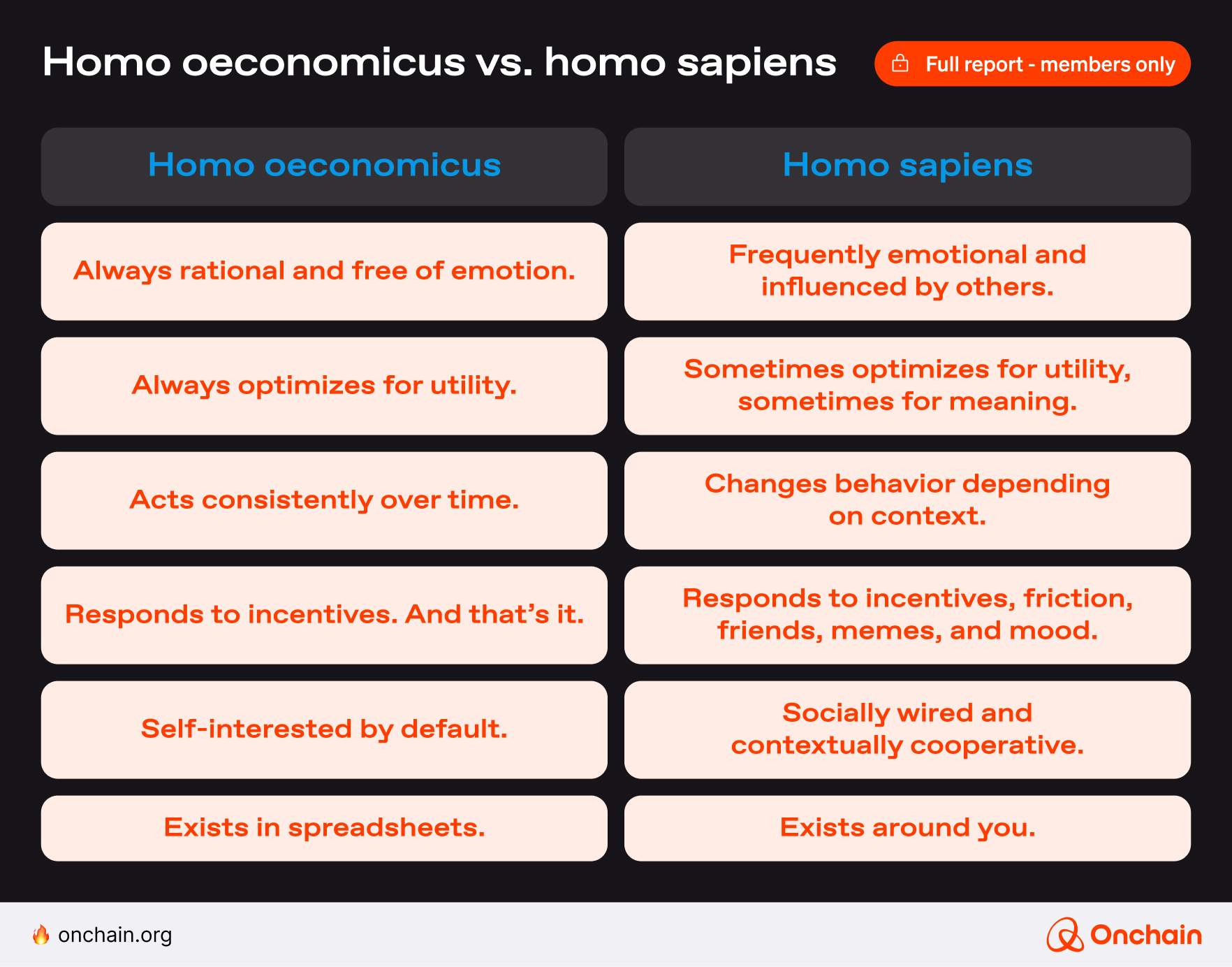
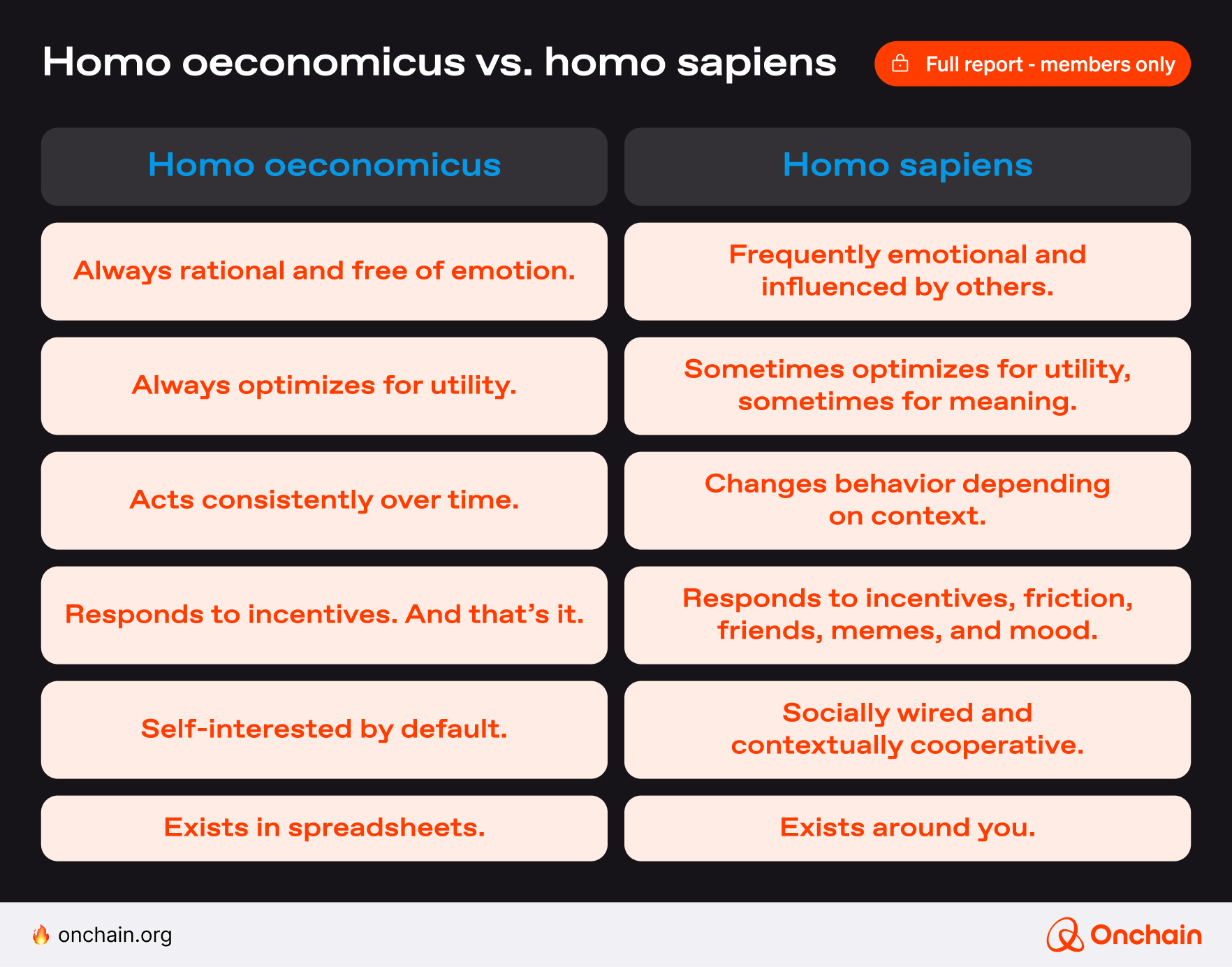
Now, let’s explore the topic of Web3 homo sapiens’ irrationality by giving you what founders like best: clear tips on how to benefit from it. This doesn’t mean manipulating or misleading them. Addressing cognitive biases is actually one of the oldest marketing tactics the world is familiar with. And it’s about time for Web3 to finally adopt it, especially if paired with the 5 elements of the Onchain Identity I outlined above.
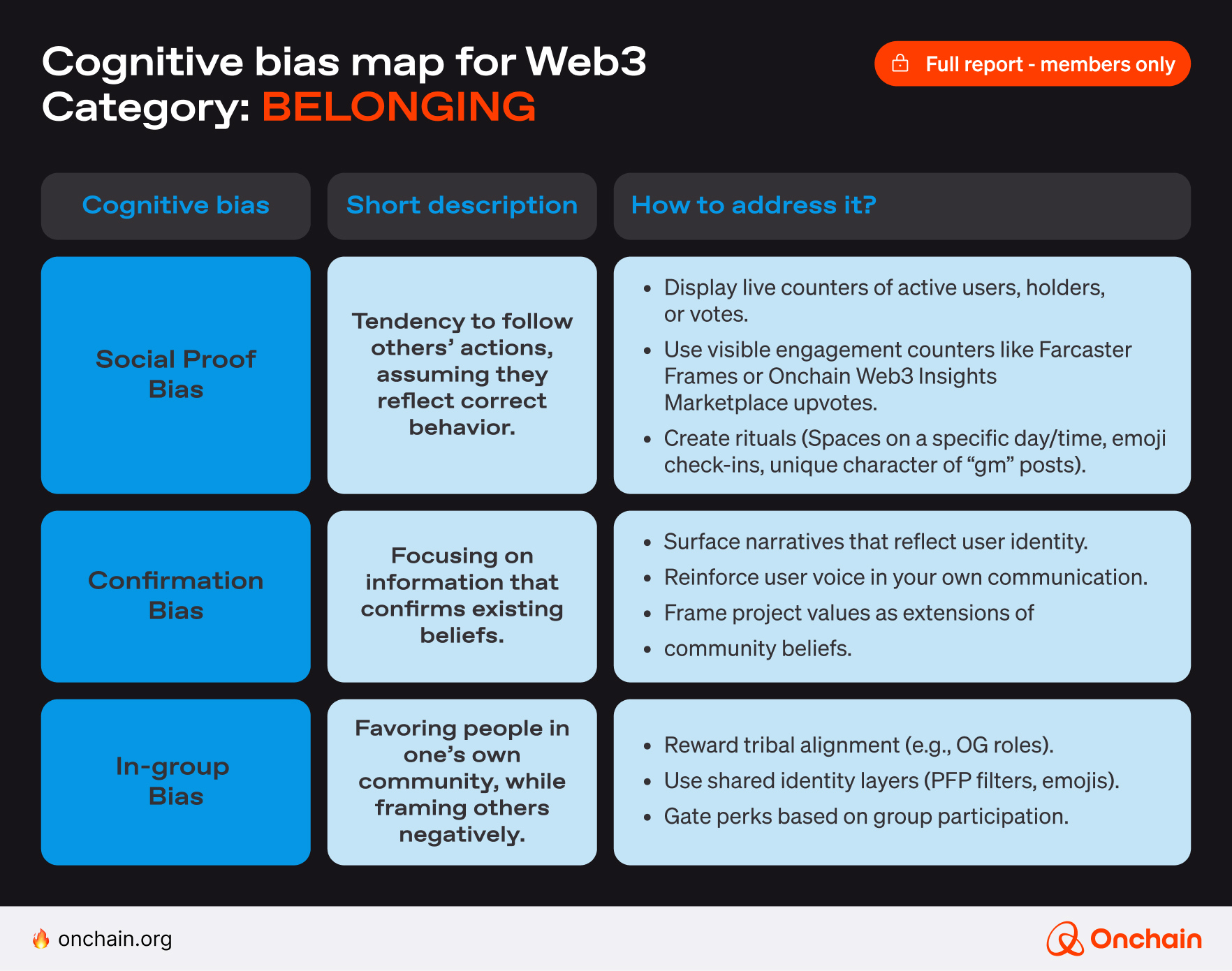
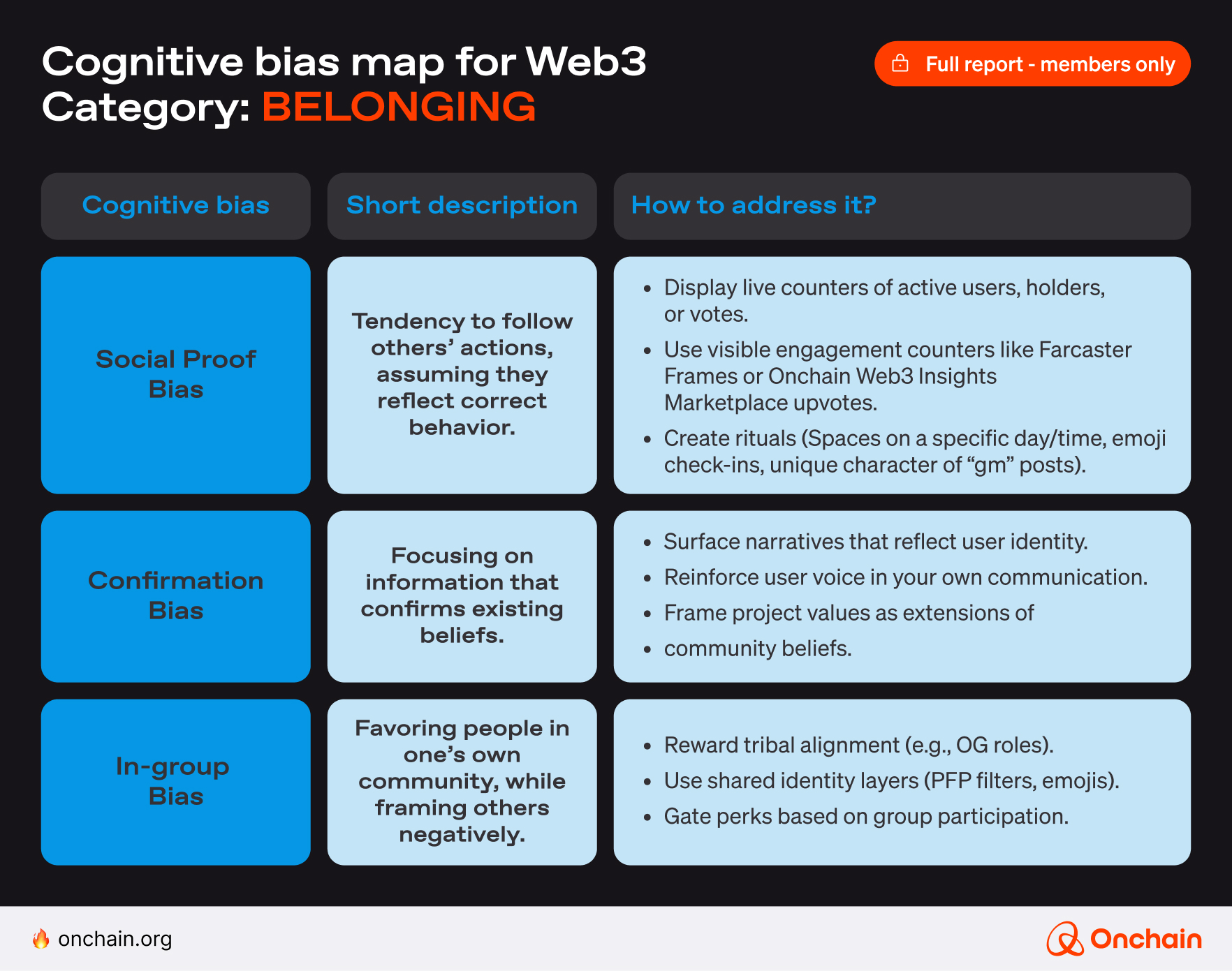
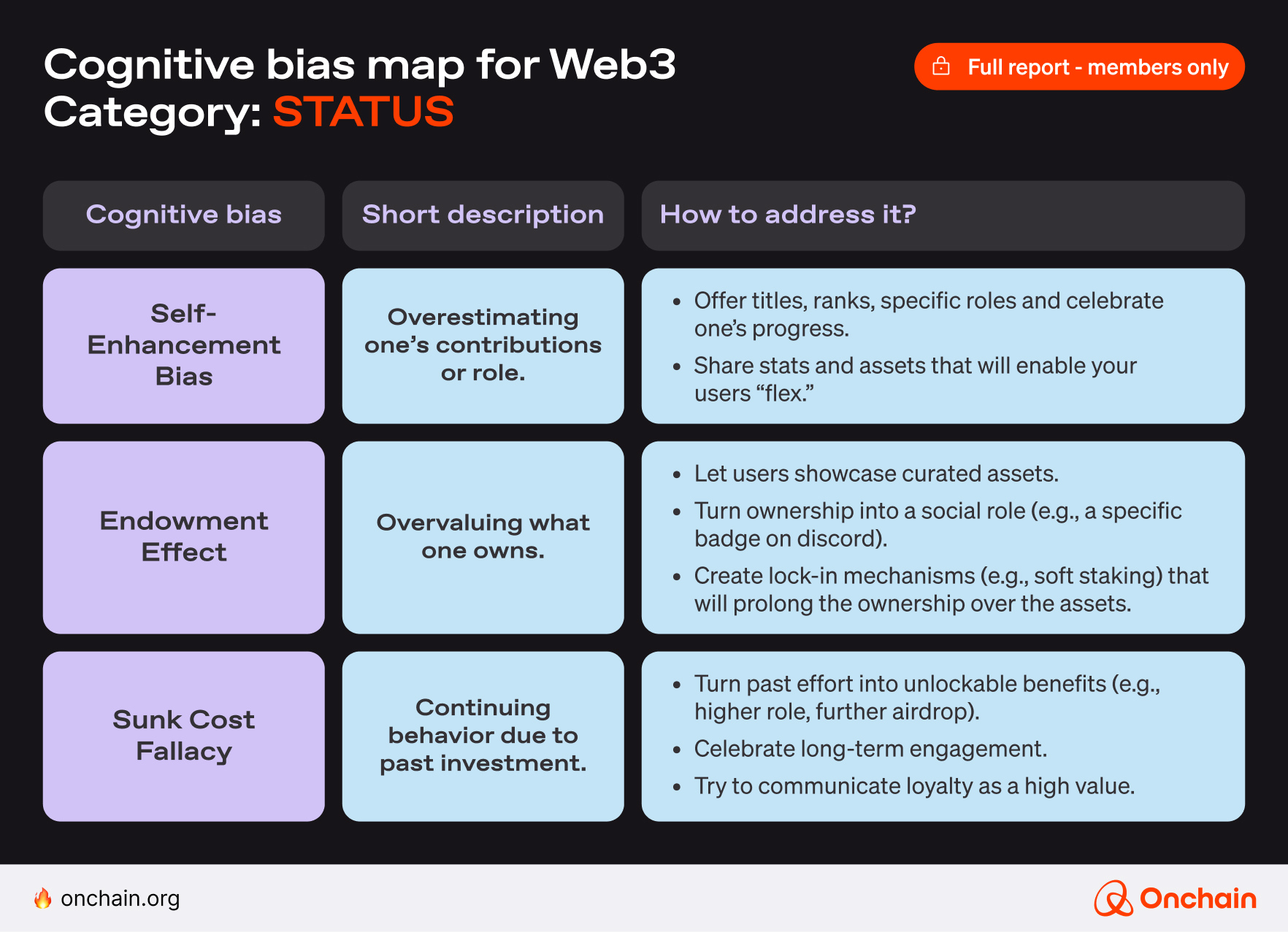
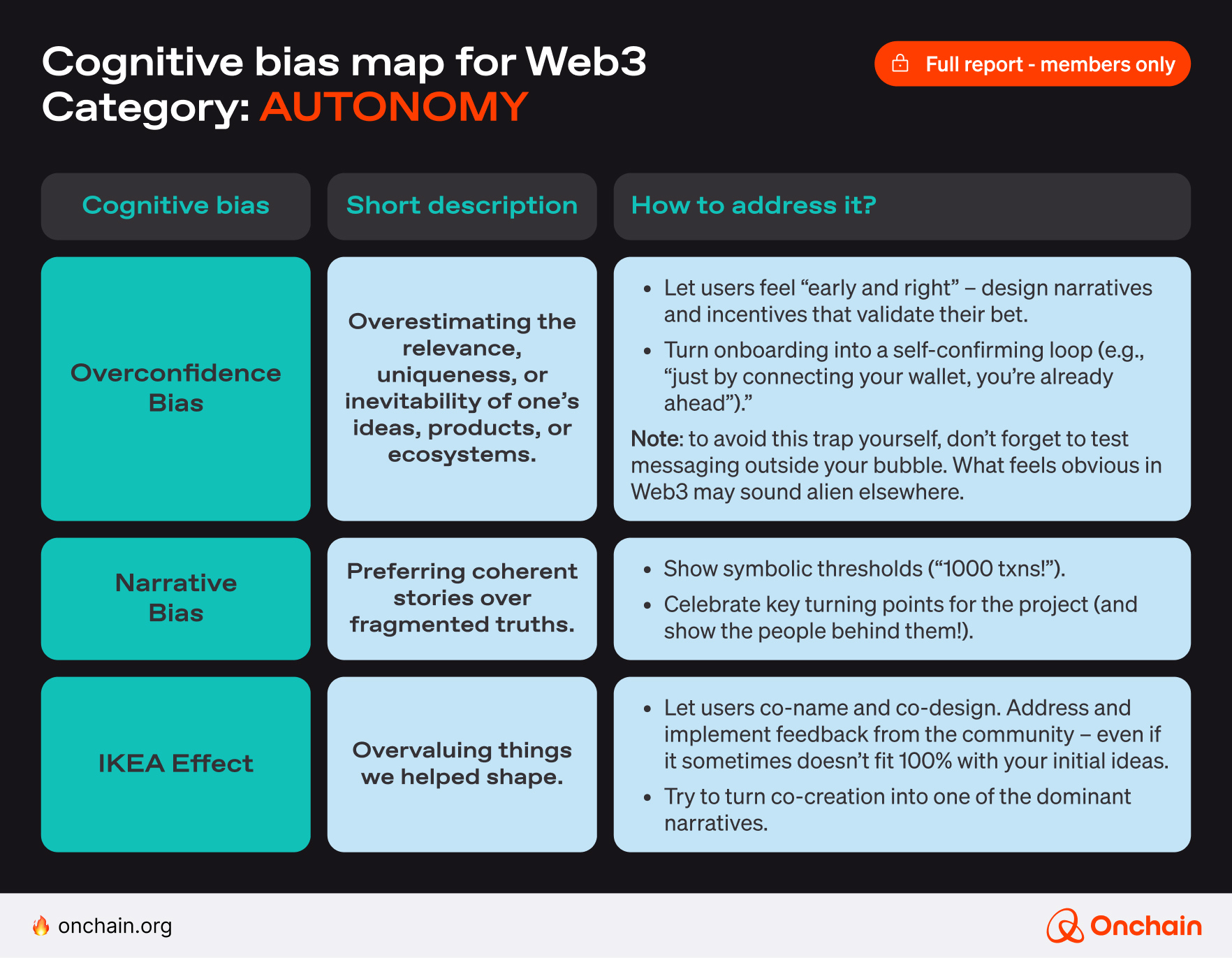
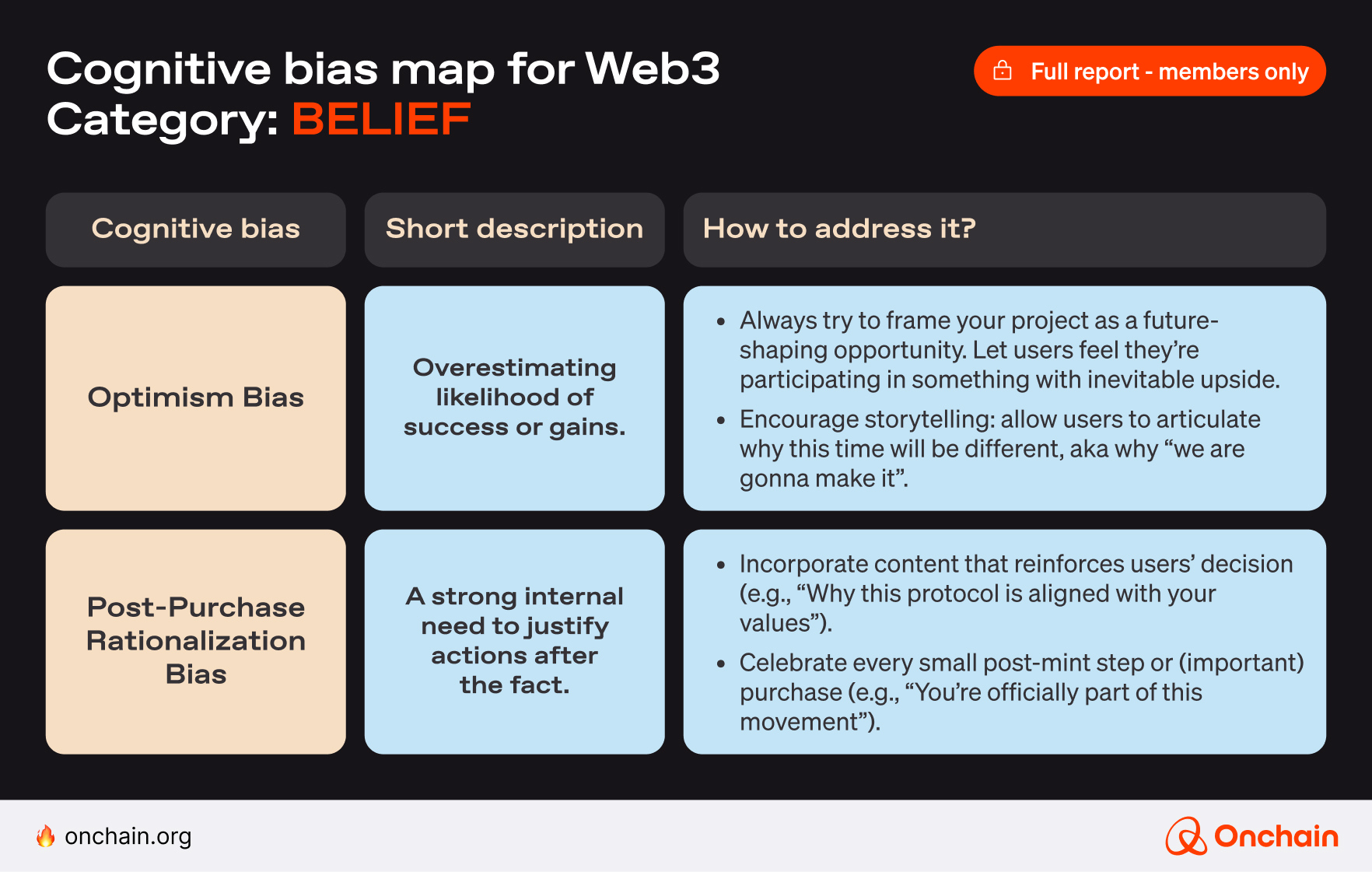
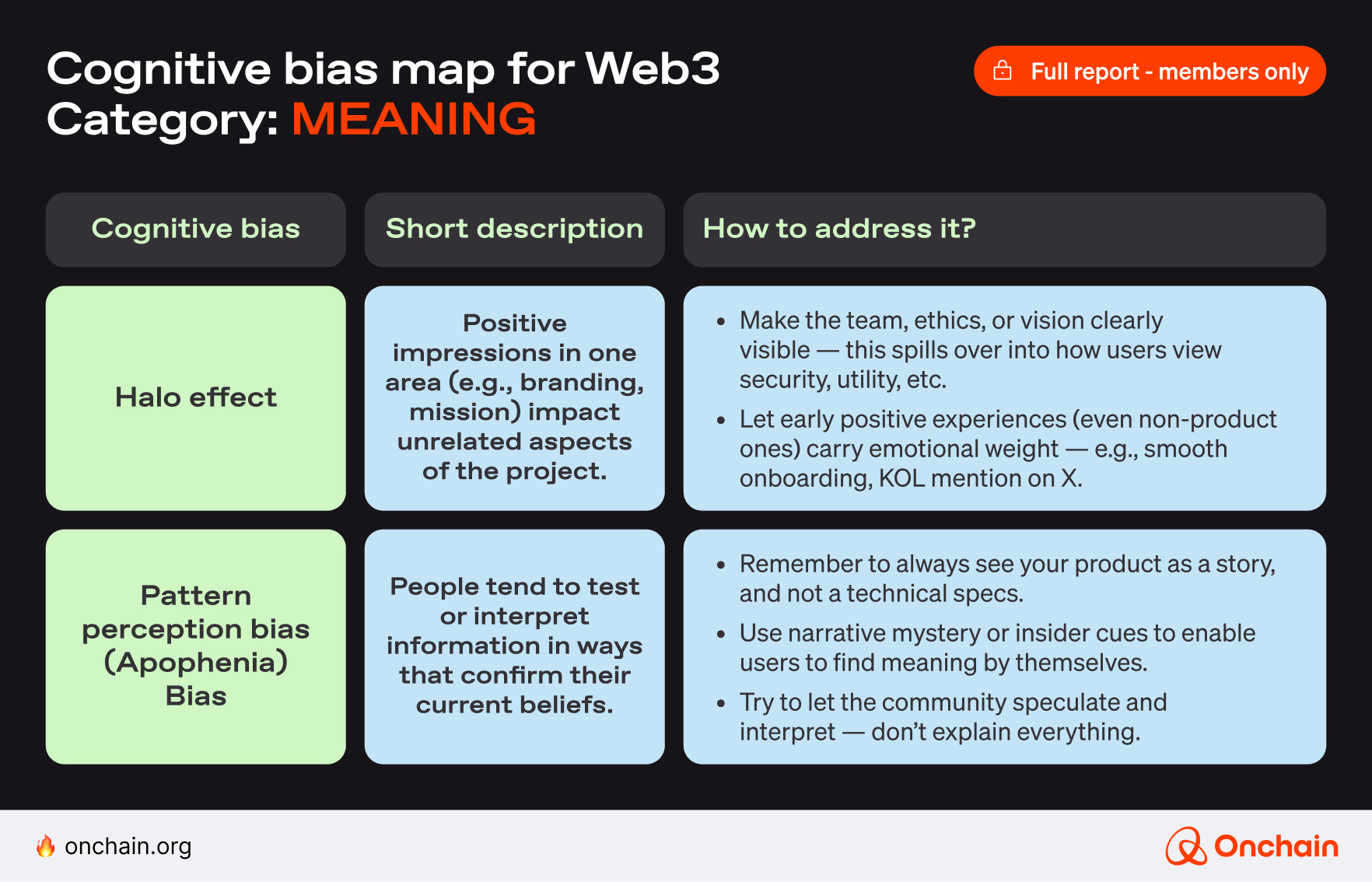
Disconnection between declaration and behavior, as well as the number of fallacies, makes the role of a founder, leader, or anyone who’d like to communicate an idea tricky. After all, if all customers were rational and alike, we’d only need to present them with a clean, benefit-maximizing offer and let logic do the work.
But it’s never that simple. Web3 users aren’t always status-driven, sovereign, or focused on community-building – they also are diverse, dynamic, and behaviorally fragmented. This is why, unlike most “Web3 user psychology” reports, I won’t force a neat typology or fixed persona system onto you.
Instead, we’d like to give you the toolkit that will enable you to analyze your specific customer (existing and potential) – so that the typology, personas, or anything else you’ll create from it, will reflect your target segment.
Part II: Designing for Web3 Behavior
Mapping mindsets: tools & models for behavior-first design
The idea of user personas is as old as marketing itself. Segment your audience, assign each group a name, a face, and a list of needs. Suddenly, the messy reality of human behavior becomes a tidy set of slides. And it works!
Or, does it?
Web3 breaks most of what these static personas were built on:
- Demographics don’t matter when people operate pseudonymously.
- Psychographics blur when the same user flips from airdrop hunting around project A to genuine liquidity providing for project B, while simultaneously trading futures on project C.
- And motivations shift based on price action, community drama, and Elon/Trump’s tweets.
That’s why I suggest moving toward behavior-first mapping, instead of using archetypes like “The NFT Collector” or “The Onchain Maximalist”. This approach is based on flexible tools that reflect what Web3 folks do, what state they’re in when they do it, and how these states evolve over time.
This goes beyond theory. Research from Symanto, Gemini, and Reown x Nansen indicates that Web3 users often enter the space driven by one motivation (e.g., profit) and remain due to something entirely different (e.g., identity, belonging, or mission alignment). And after reading the earlier chapters, this should sound familiar:
Users enter with biases → They adopt narratives → They join communities → And then they reshape their beliefs to fit the role they ended up playing.
Next, let’s explore the tools that help you observe, map, and design for exactly that. Instead of a general Web3 user, work with your Web3 user in mind.
Founder’s toolkit: behavior-centric mapping tools
Below, I introduce a set of flexible methods to uncover the motivations, patterns, and psychological states of your Web3 users. None of them require extensive research, but a shift in mindset: from static customer segmentation to decoding dynamic behavior.
The tools below were put in specific order, so that you can start with general data collected from your users and end with the actual (sometimes nonlinear) paths from preferences to action.
- Empathy Mapping – mapping the emotional states of your users.
- Jobs to Be Done (JTBD) – uncovering the motivations and goals toward your products.
- Wallet Behavior Clustering – segmenting users based on the actual onchain activity patterns.
- Decision Journey Mapping – identifying the ultimate, real (and nonlinear) path from discovery to action.
We prepared a brief description for each, followed by their specific goals, the methods for collecting data, and a few AI-based tips on how to expedite the process. Each mini-section also contains templates and examples. I hope you enjoy and use them!
1. Empathy mapping
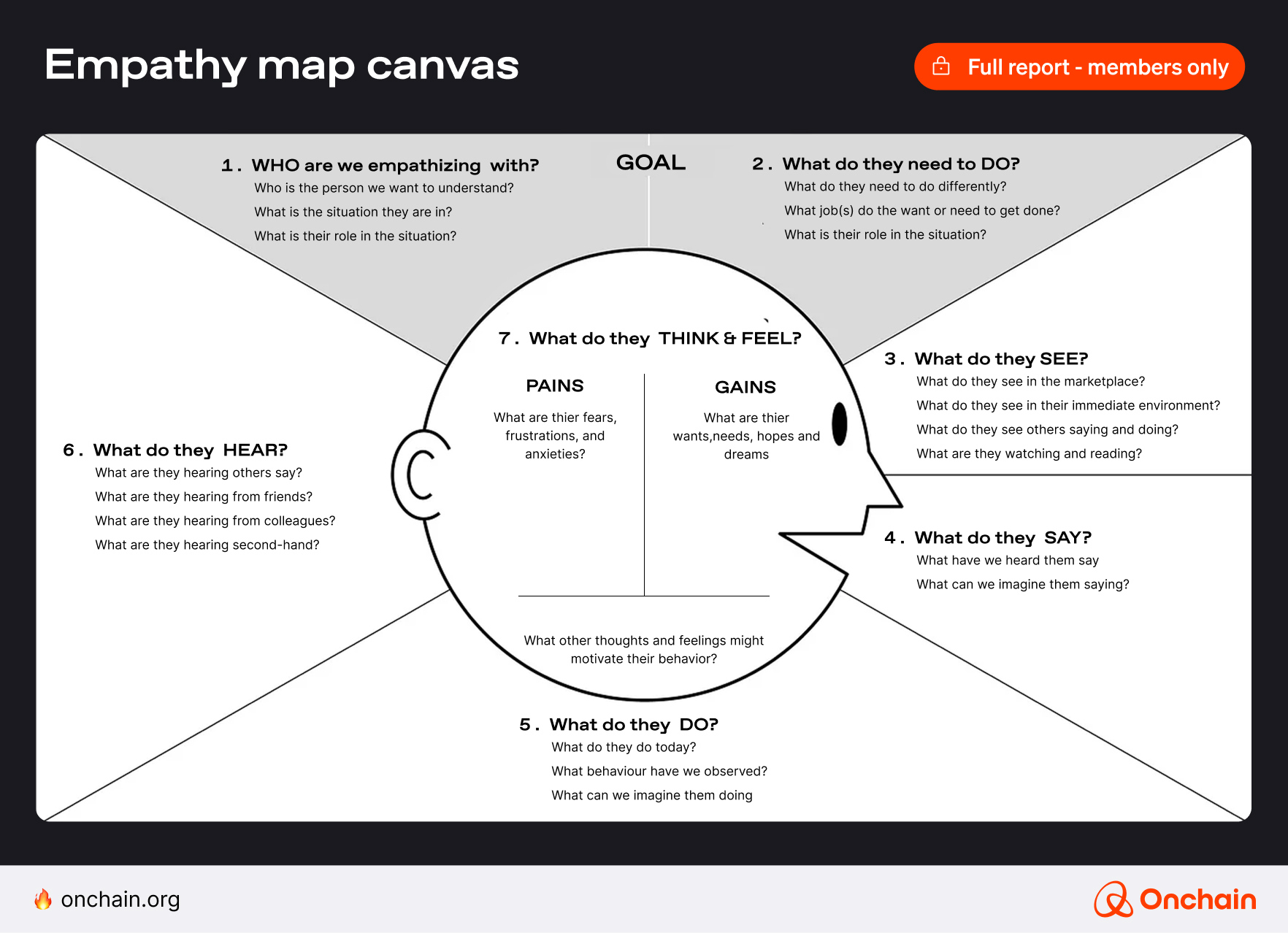
Empathy maps serve as a tool to visualize what a person is thinking, feeling, saying, and doing at a particular moment, especially when these don’t align. They help you uncover what’s going on in a user’s inner world when they interact with your product, token, or other community members.
1a. Why does it work?
As mentioned above, humans are not inherently consistent. We often do one thing, say another, and feel something else entirely. Empathy maps help capture all.
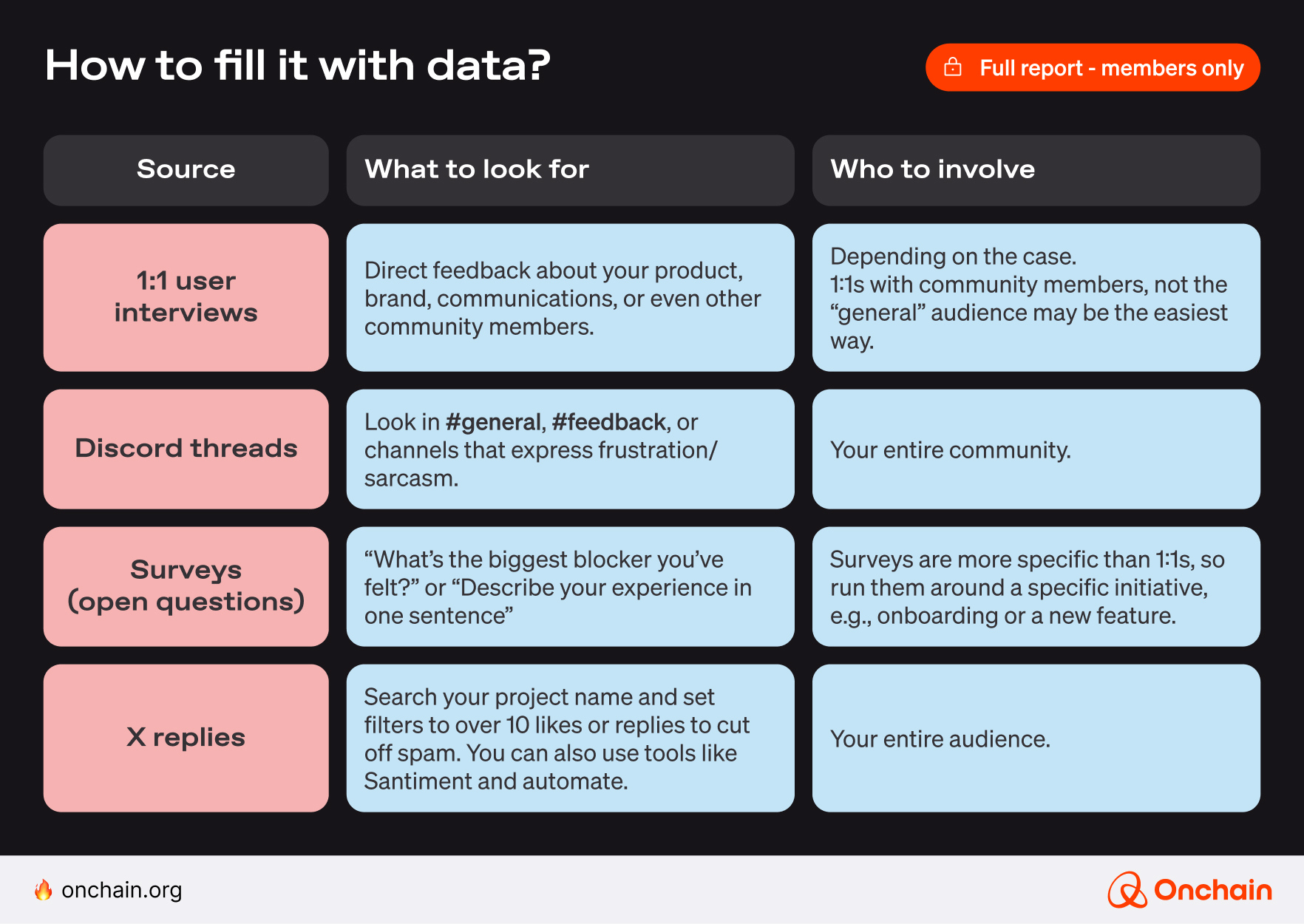
1b. How to use AI to speed up your work?
- Synthesize and categorize dozens of freeform survey responses into a 4-quadrant empathy map (as in the canvas above).
- Extract contradictions from call transcripts: “Says they believe in decentralization, but never voted.”
- Run an automated sentiment analysis of discovered X replies.
1c. Here’s an example of what you might discover
Sample case: On a DeFi platform, when staking, users deposit once, and then disappear.
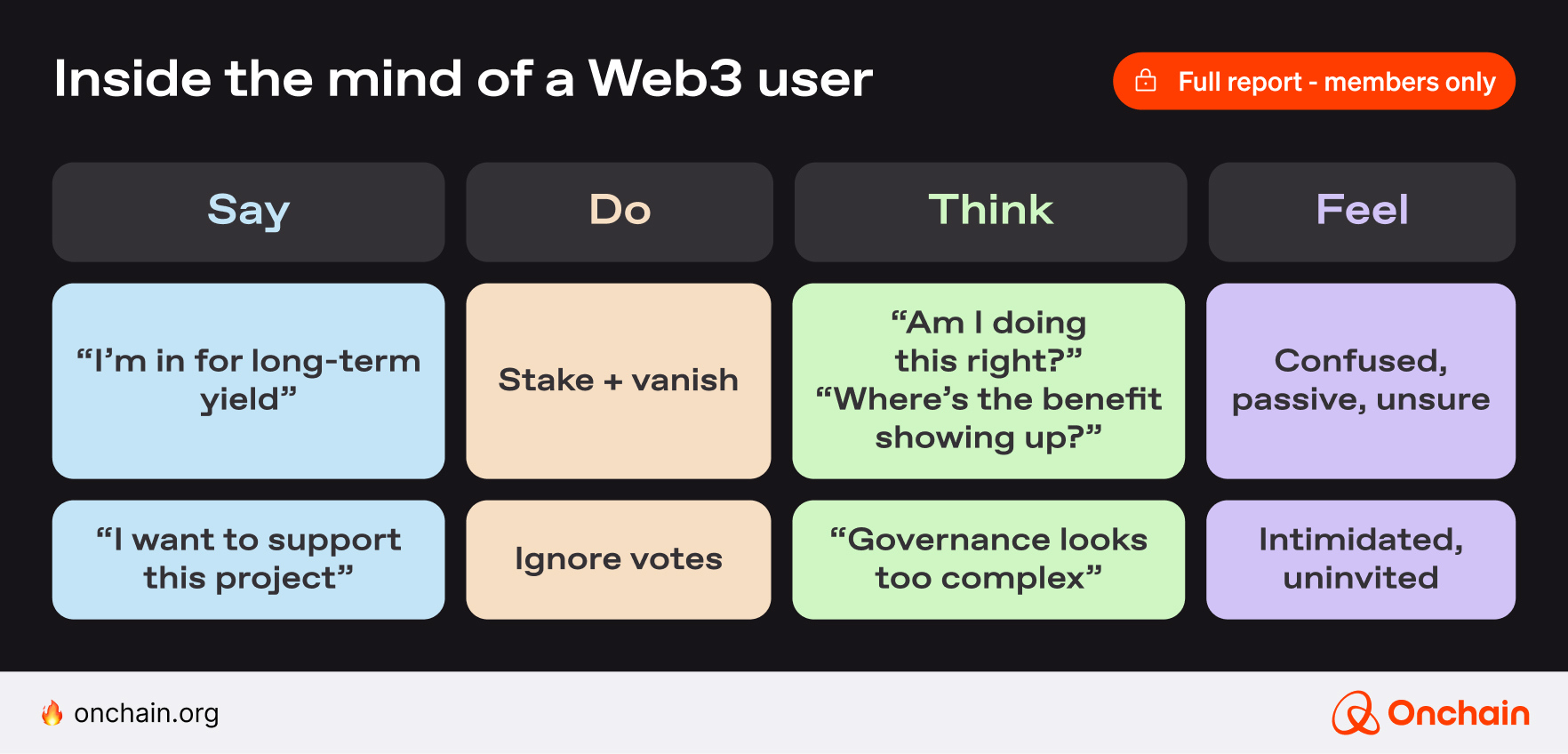
Insight: Users aren’t disengaged, but simply overwhelmed.
Implication: Simplify the post-staking flow. Offer a “what happens next” explainer, soft onboarding into governance, and optional nudges rather than dashboards full of metrics.
Please note that the usual empathy map findings will be way longer and insightful. The one above serves only as an example.
1d. Templates to use
2. Jobs to be done (JTBD)
Jobs to Be Done is a way of understanding what your users are actually trying to accomplish, not in terms of features, but in terms of the outcomes they seek. So, while Empathy Maps reveal a lot about their feelings, JBTD attempts to explain their goals and motivations.
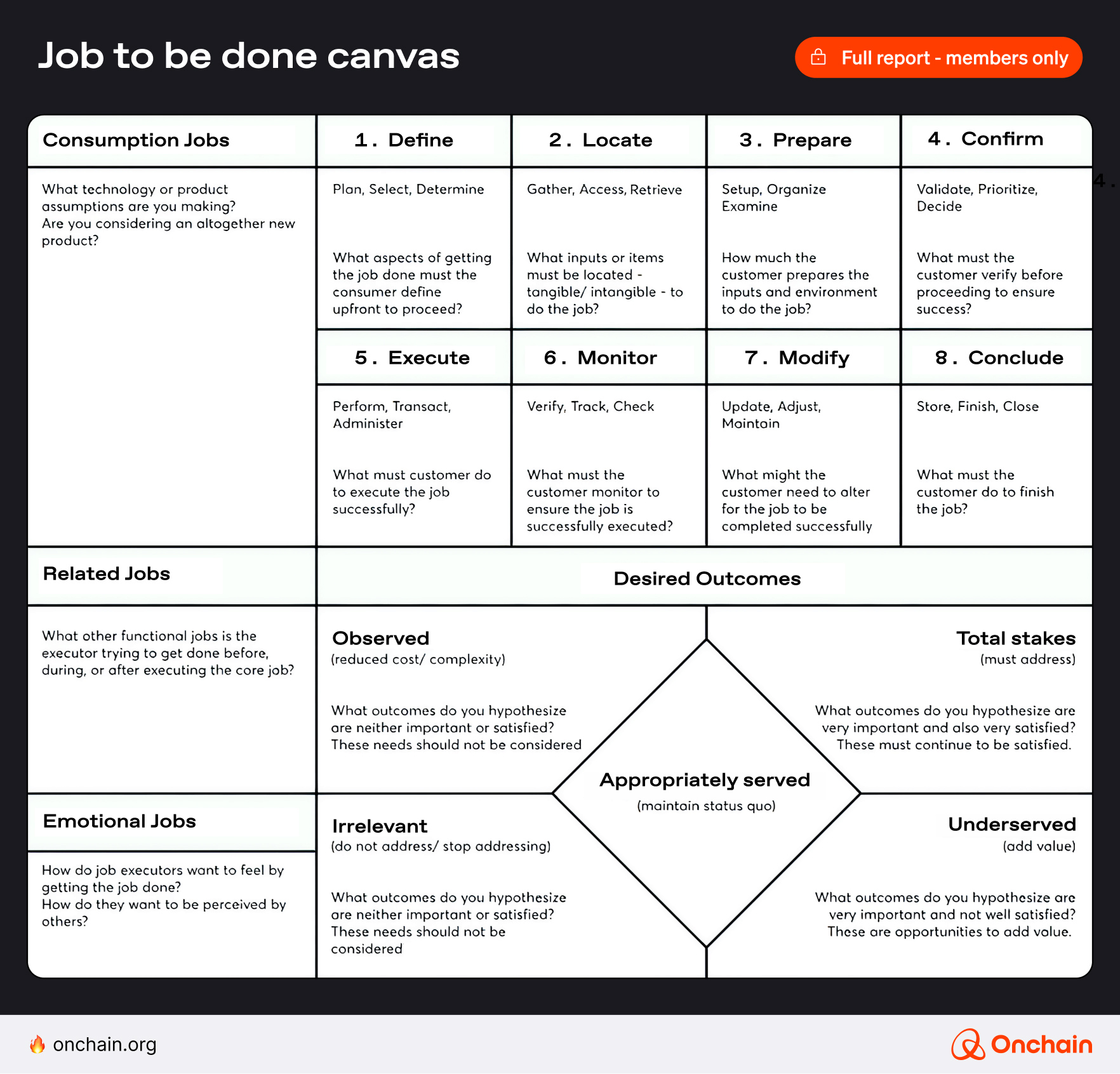
2a. Why does it work?
JTBD helps you design based on the reasons people come in the first place – and what makes them stay. When paired with Empathy Maps, you can connect their goals with emotions. This is particularly valuable for Web3, as most use cases are emotional and centered on concepts such as belonging, identity, or status.
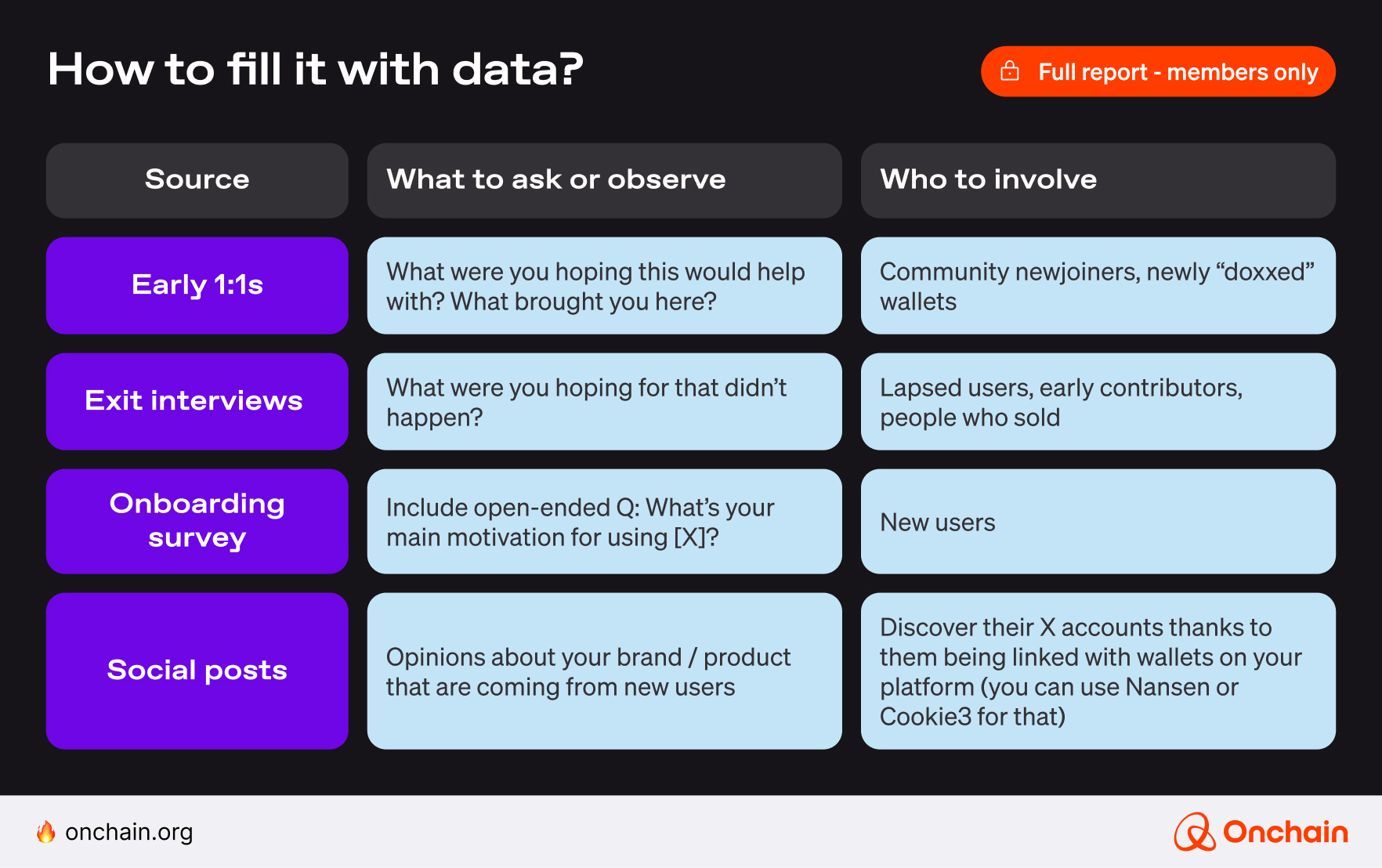
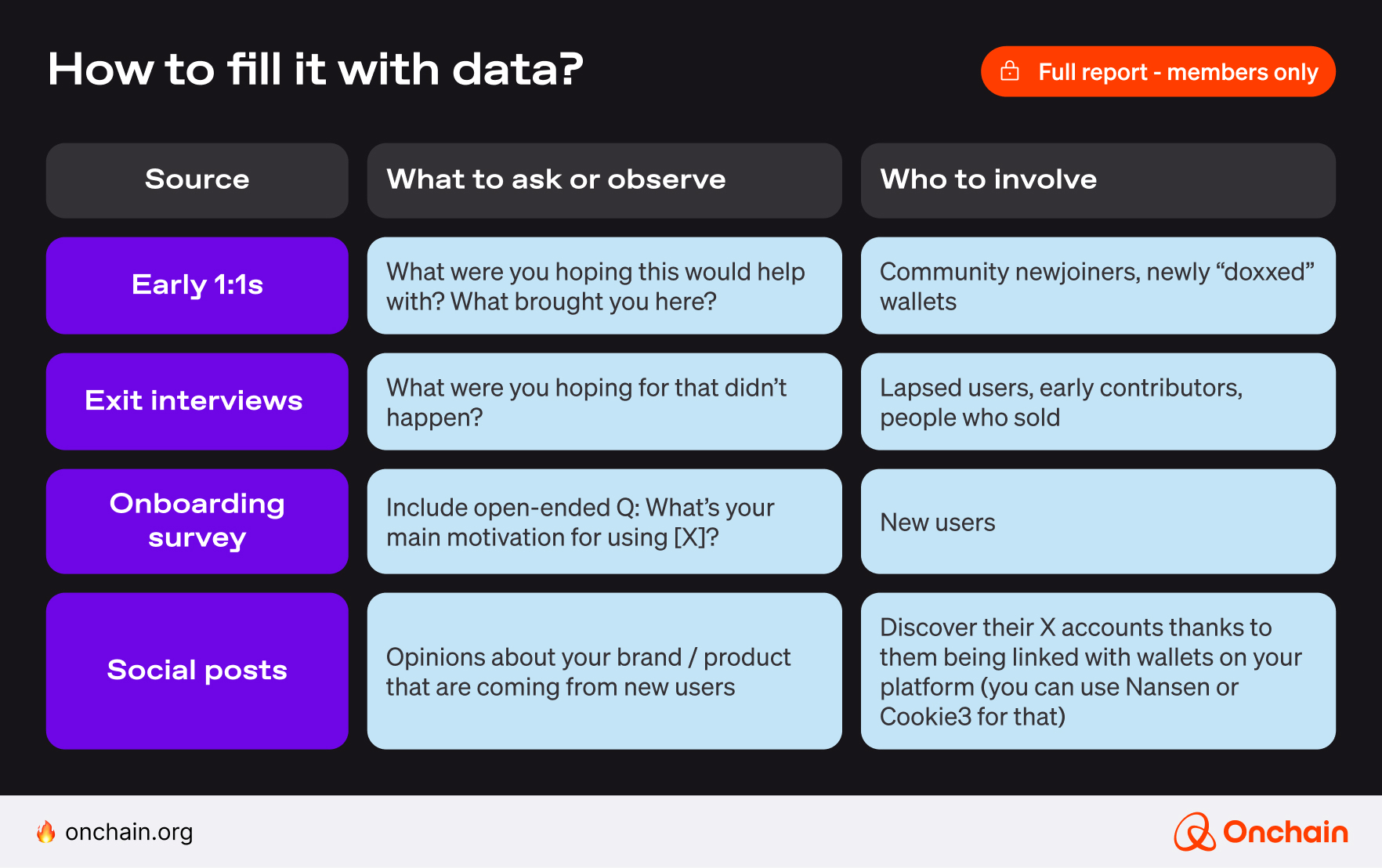
2b. How to use AI to speed up your work?
- Parse interview transcripts and cluster responses by jobs.
- Rewrite vague motivations as clear JTBD statements.
- Automatically distinguish between emotional vs. functional “jobs” (e.g., belonging vs. utility).
2c. Here’s an example of what you might discover.
Sample case: You’re building a DePIN project that rewards users for contributing sensor data. You’re seeing good hardware adoption, but erratic engagement.
- Situation/Context: I just received my hardware node from a DePIN project I discovered on X.
- Motivation/Trigger: I saw people posting their reward screenshots and setup stats.
- Desired Outcome: I want to install and configure it quickly, so I can start earning and feel early.
- Main Job to Be Done: “When I get access to new onchain hardware, I want to contribute fast and visibly, so I can feel like I’m helping build the next big thing.”
- Pains/Frictions: Setup guides are unclear. I’m not sure if my location is ideal. No one validates my impact.
- Gains/Rewards: Tokens, yes. But more importantly, recognition — a sense of early builder status and visible contribution to something real.
Insight: Users aren’t just “mining,” but rather trying to reclaim meaning, reputation, or early-mover status.
Implication: Surface emotional payoffs, not just token rewards. Show how contributions build real infrastructure. Offer public-facing “impact dashboards” or social badges that let users showcase their role.
2d. Templates
- Template by Netgru (quite extensive)
- Template by Digital Leadership (simplified)
- You can also use the classic JTBD format and group jobs of your customers into sentences like: When I [situation], I want to [job], so I can [outcome].
3. Wallet behavior clustering
Empathy maps and JTBD interviews help uncover motivations and internal narratives. Wallet behavior clustering provides an additional, unique layer of information: observable, provable (thanks to blockchain, yes!) patterns of action.
3a. Why does it work?
- Helps uncover pseudonymous behaviors and attach them to actual customers.
- Clustering helps avoid the persona fallacy – users often don’t act as they describe themselves.
- When paired with JTBD or empathy maps, it completes the triangle: Emotion → Intent → Behavior.
3b. How to use AI to speed up your work?
- Feed ChatGPT structured wallet activity summaries and ask it to identify patterns.
- Cluster labeled data into named segments.
- Use it to compare behavior types against public narratives (by checking if users under a specific “label” indeed perform the expected actions).
3c. Here’s an example of what you might discover.
Sample case: A DePIN project notices wildly inconsistent contributor behavior: some users spike then vanish, others contribute slowly but regularly.
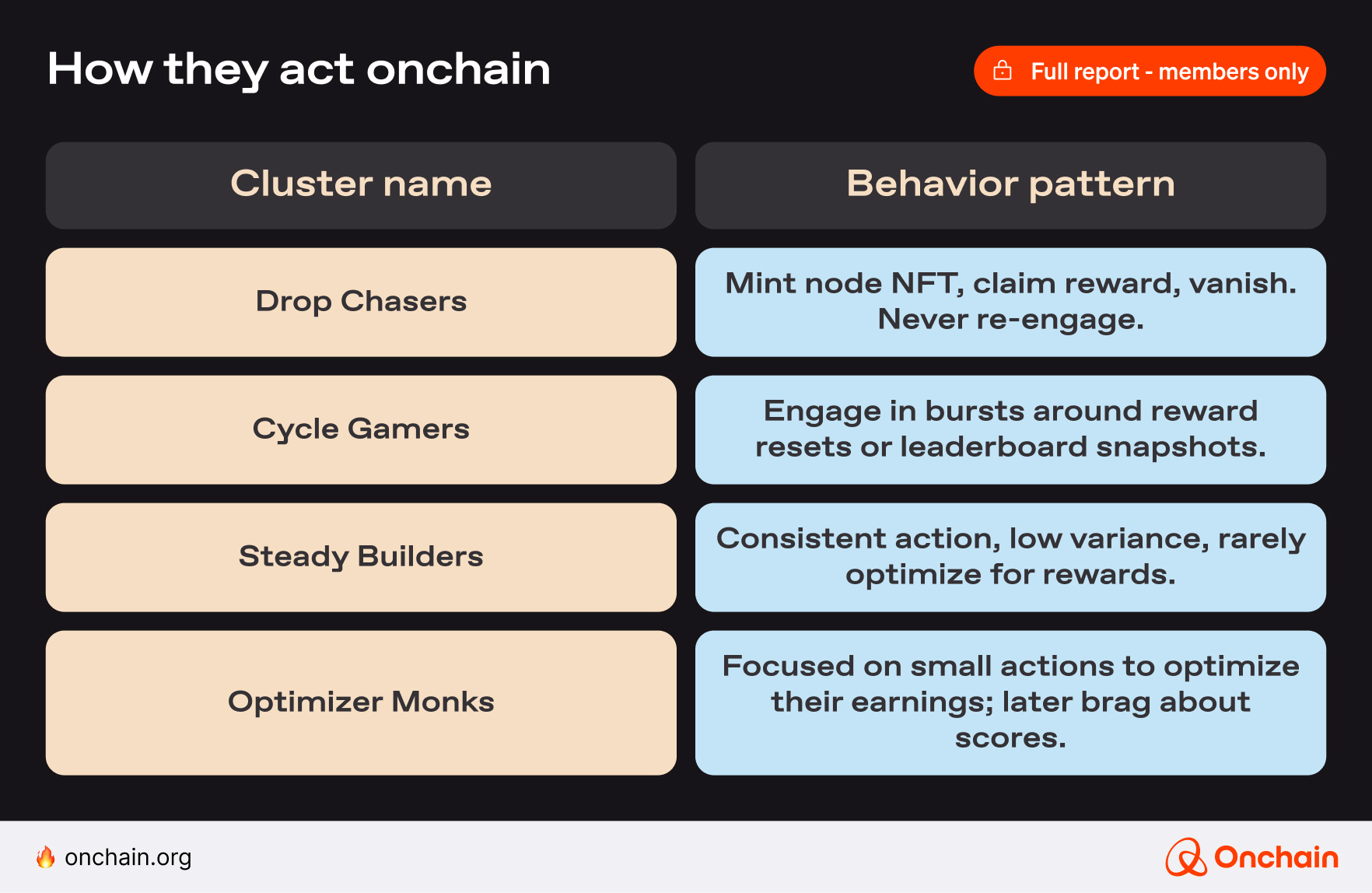
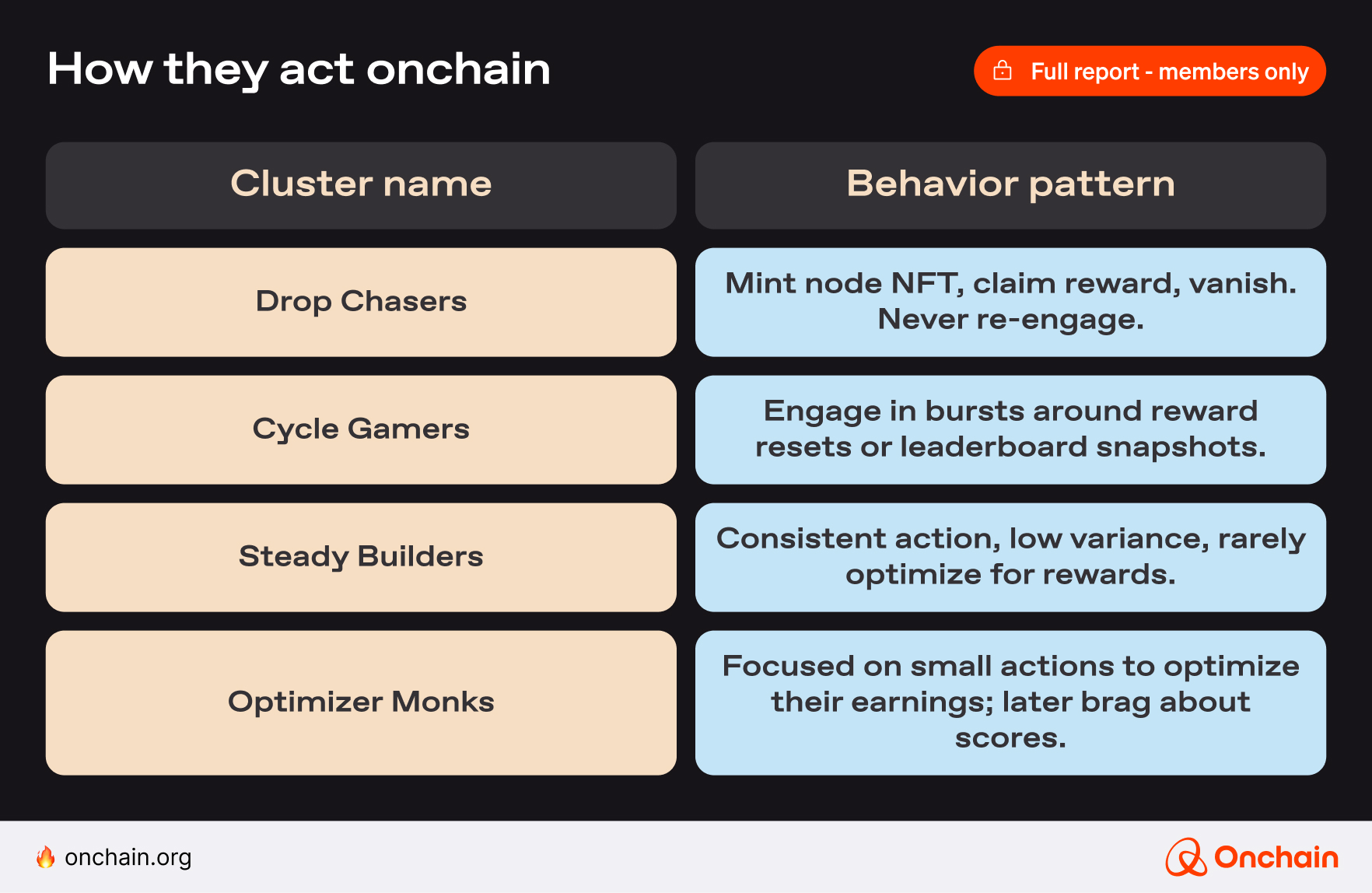
Insight: Drop Chasers aren’t bad actors. They’re motivated by event-based participation, rather than ongoing alignment.
Implication: Build rituals for Builders, and optimize leaderboard visibility for Monks. Let Chasers have their moment, but don’t design around them.
3d. Templates
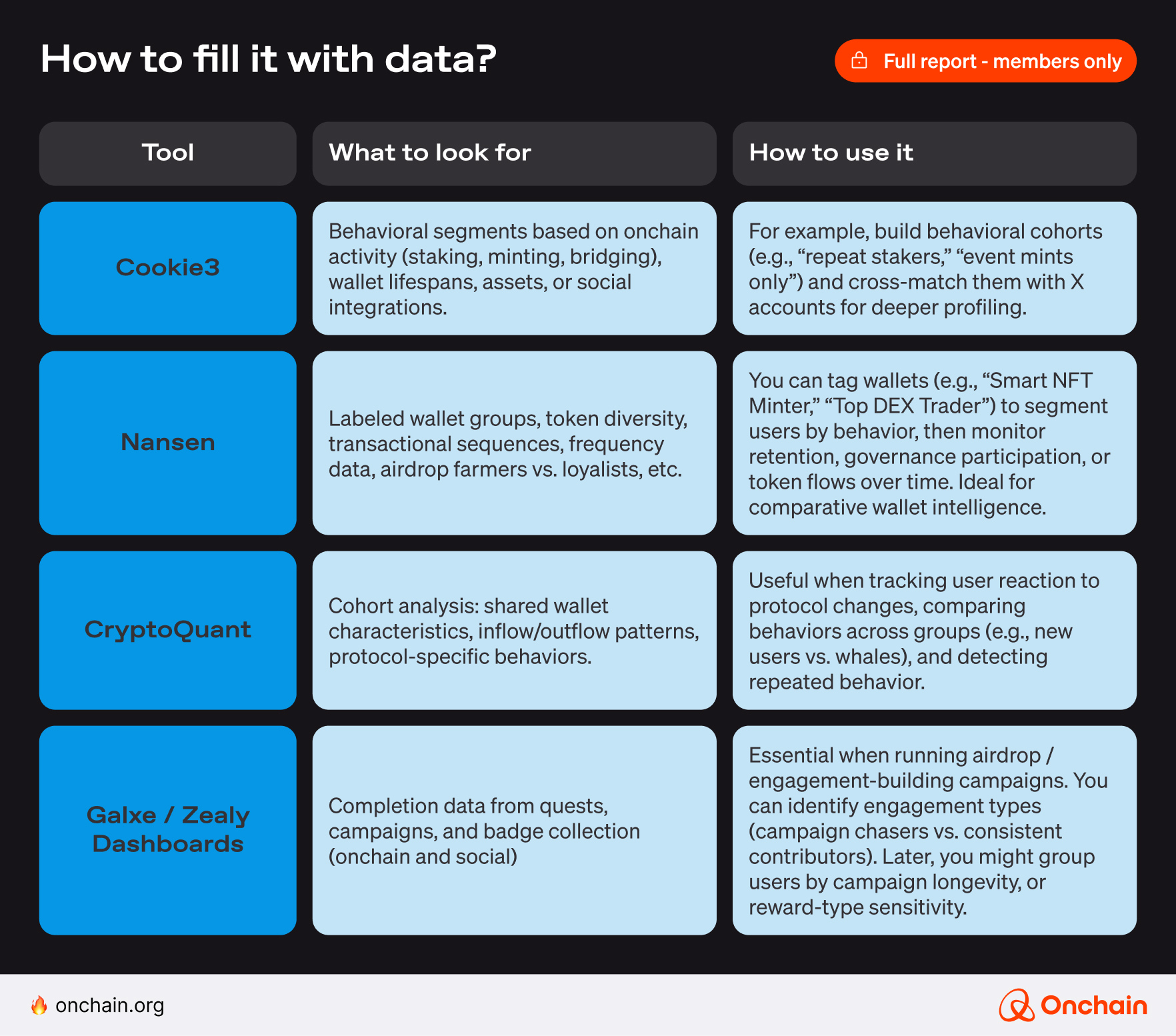
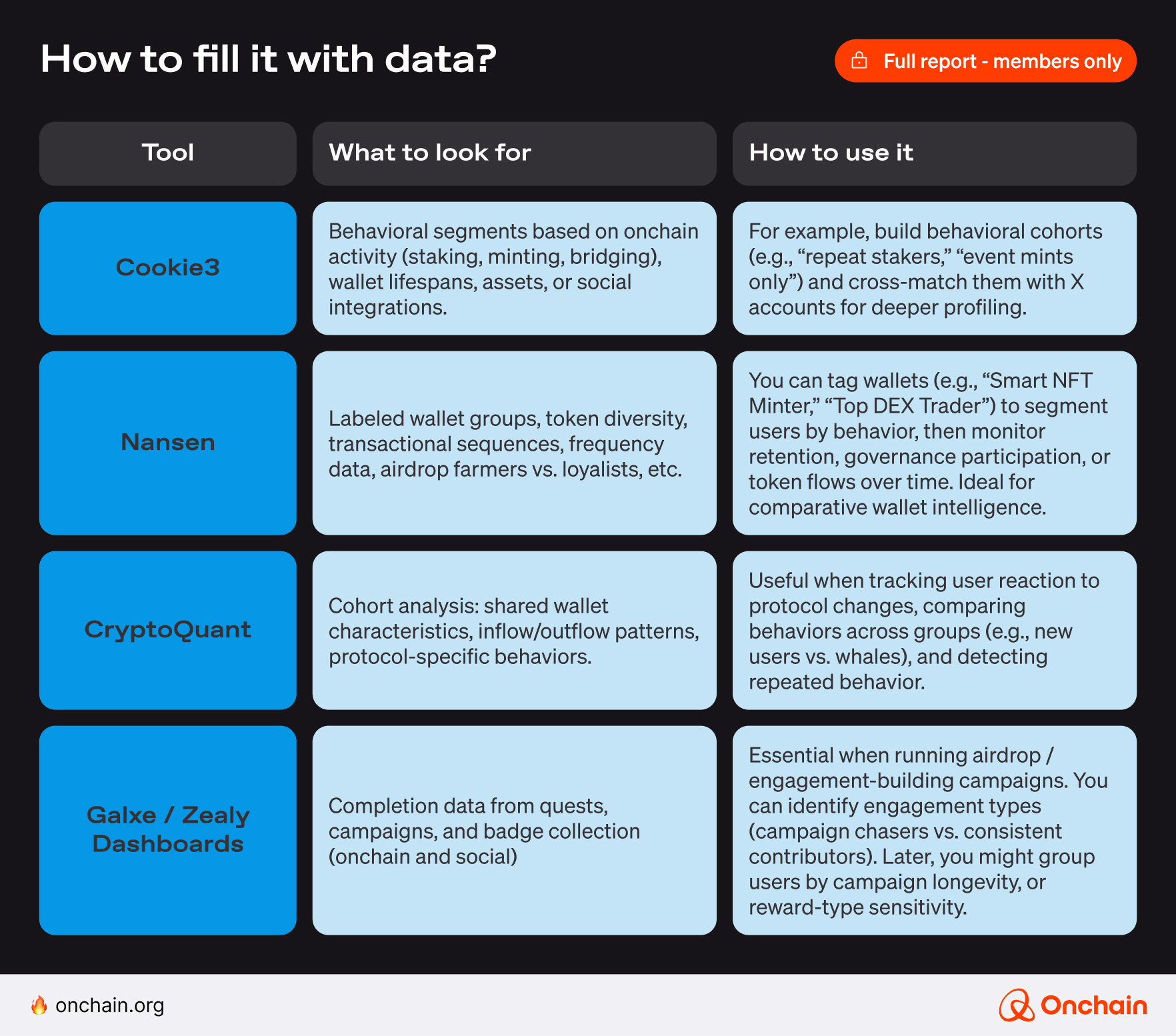
There’s no ready-made wallet clustering template. However, below, you can find a method that you can use together with Cookie3, Nansen, or CryptoQuant, and then synthesize your clusters using a spreadsheet, Miro, or ChatGPT.
- Extract data using Cookie3, Nansen, or CryptoQuant: Focus on frequency, behavior type (mint, stake, vote), and sequences.
- Create clusters based on patterns: Label groups like “Ritual Minters,” “Cycle Gamers,” “Silent Loyalists,” etc.
- Create behavioral labels for each cluster: Describe what they do, when they do it, and why that matters.
- “Ritual Minters” – weekly activity, high retention.
- “Cycle Gamers” – spike around incentives.
- “Silent Loyalists” – stake and disappear, but never sell.
- …
- Visualize or tag clusters in Airtable / Miro / Notion.
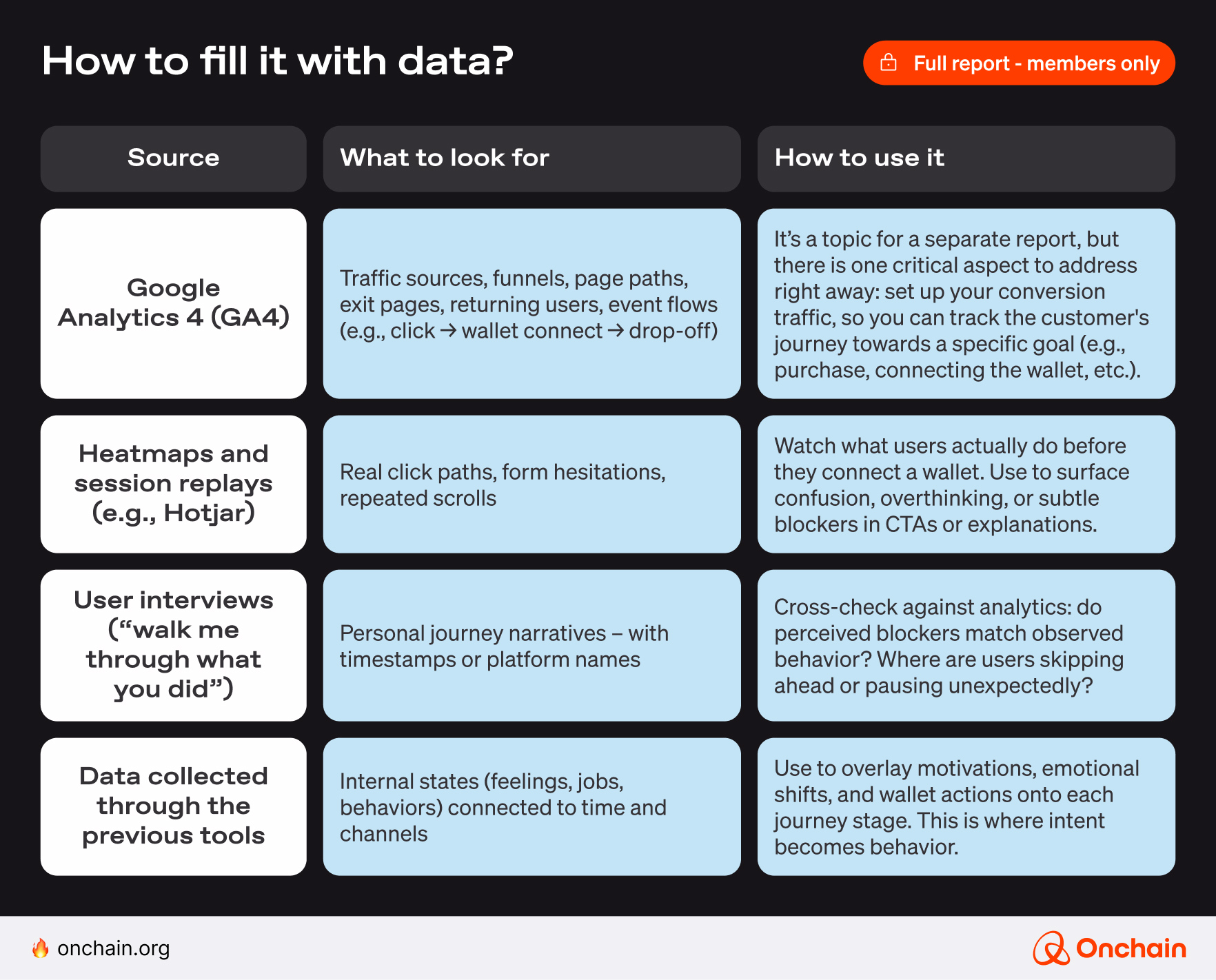
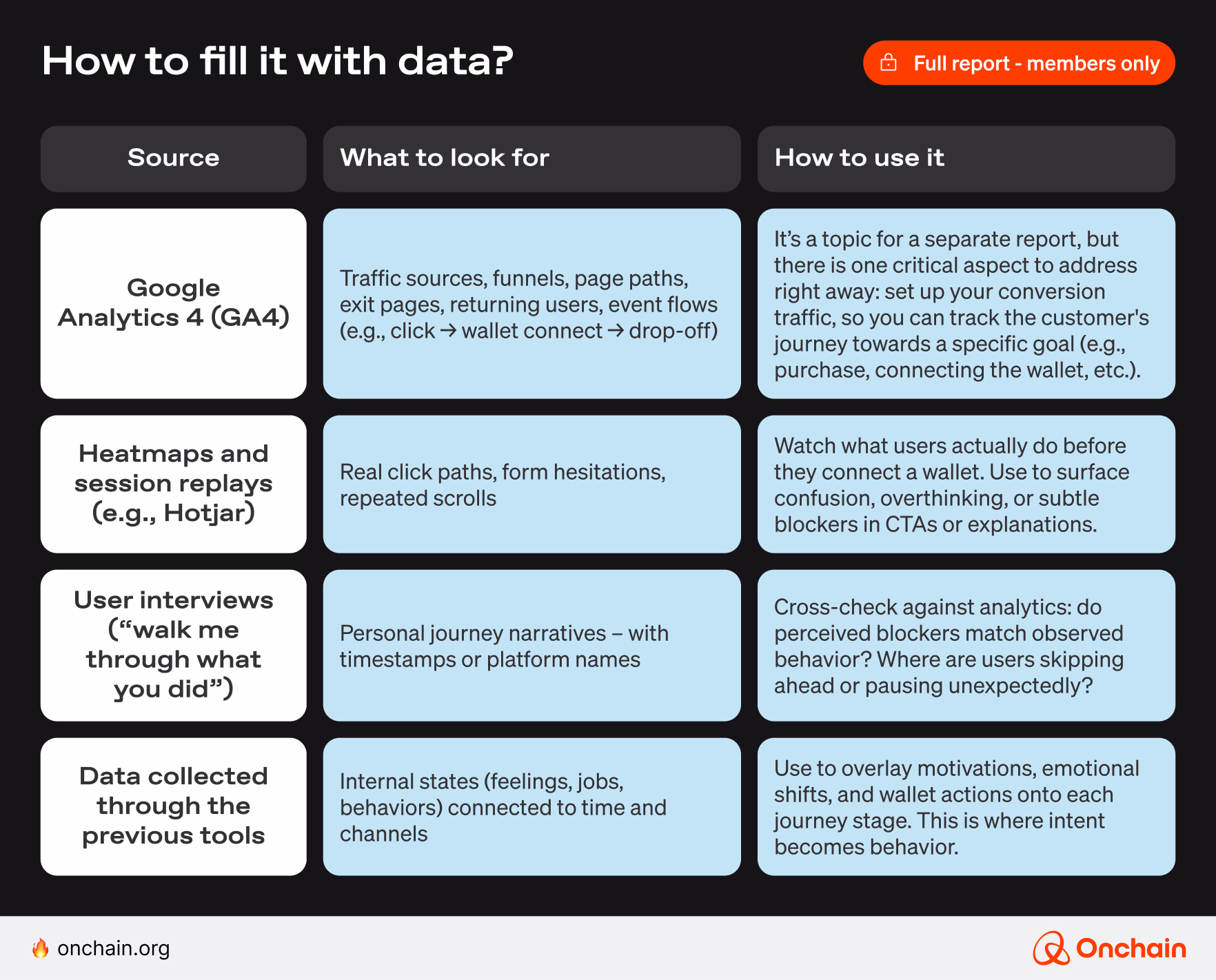
4. Decision journey mapping
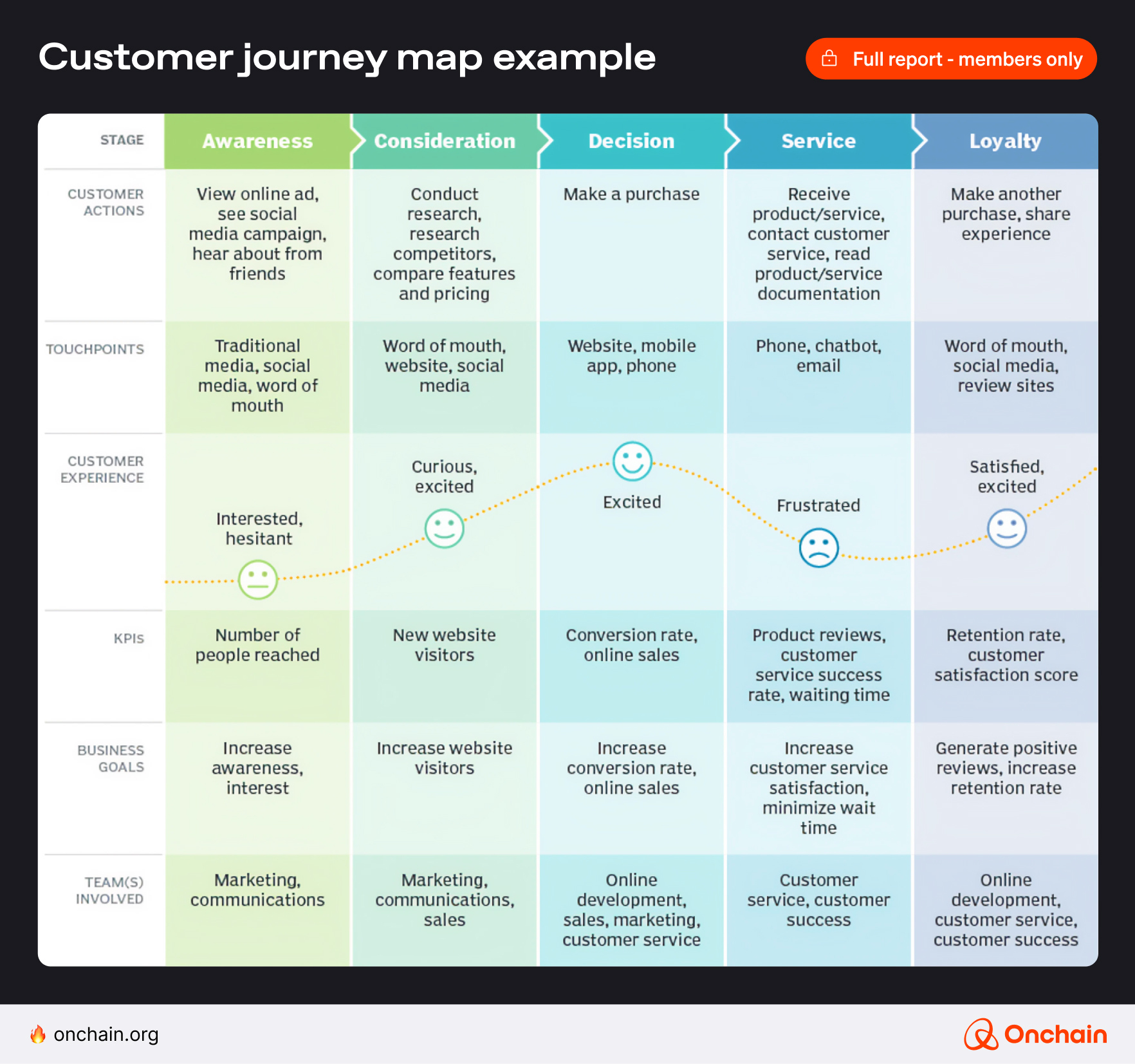
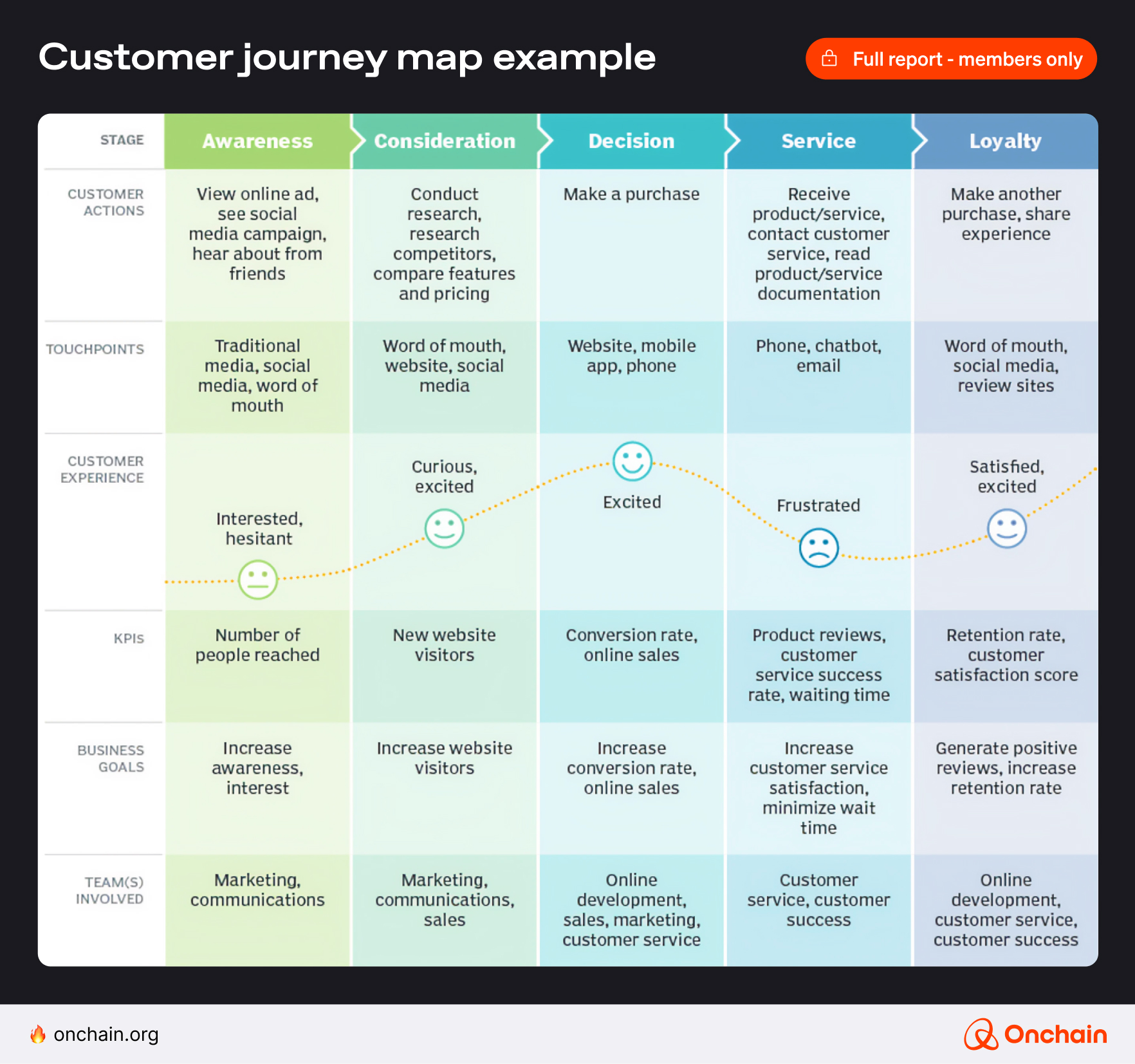
This tool helps you fill the last gap in understanding your Web3 customer. With decision journey mapping, you’ll discover when and how your users act or stall.
It also allows you to structure their entire journey, incorporating the data you’ve already collected about feelings and emotions (Empathy Maps), goals and motivations (JTBD), and onchain behavior (Wallet Clustering).
4a. Why does it work?
- It helps you structure the entire user flow using actual steps, not assumptions.
- It anchors abstract findings in real environments, especially your website or app, where most decisions are made.
- It enables you to form hypotheses based on the collected data (e.g., only 0.5% of users connect the wallet when using a mobile, when compared to 4.6% on a desktop → a UX issue on a mobile).
4b. How to use AI to speed up your work?
- Extract key steps, hesitation points, and emotions from interview transcripts.
- Indicate patterns in data about user paths (exported from Google Analytics).
- Rewrite user stories (based on transcripts or your notes) as structured journey maps.
4c. Here’s an example of what you might discover.
Case: Your DeFi protocol boasts a sleek UX, a strong community, and substantial site traffic; however, wallet connection rates are low on mobile devices, and governance participation is nearly nonexistent.
You interview 6 users and analyze GA4 data. You reconstruct the common journey:
- See a friend mention the project on X
- Tap the link on the mobile → land on the site
- Scroll, skim the docs, and try to connect the wallet
- Wallet opens → closes → confusion
- Bounce
- Later return via desktop (only 14% of the initial group of users) → connect wallet
- Vote
Insight: The journey breaks not from lack of interest, but due to friction on mobile and unclear next steps post-onboarding.
Implications: (1) fix mobile wallet UX; (2) add a “What’s next?” moment after wallet connect; (3) show others voting live (social proof) or offer first-time voter cues.
4d. Templates
- ColumbiaRoad’s canvas (extensive)
- TechTarget’s canvas (simplified)
- Miro Journey Maps
From Onchain Psychology to Product–Market Fit
There’s no shortage of frameworks for designing Web3 products or planning growth strategies. One could say that the only missing piece in this onchain playbook is a neat typology of crypto consumers. Something that would let you plug in all the tactics, assign the right play to the right user, and finally connect the dots.
However, this report wasn’t written to tell you who the onchain user is. That would miss the point. Web3 isn’t a single category of people or even a set of multiple, nicely defined segments. It’s a space in which people continually and constantly construct meaning, shape their own identity, and navigate through uncertainty. It’s impossible to categorize them comprehensively and show that:
- Segment A needs tactics C and D
- Segment B responds better to incentive E or F
Instead, we’ve explored the emotional mechanics of participation: What makes people enter, why they stay, and what turns initial intent into long-term behavior. We’ve walked through the biases that distort decisions, the patterns that emerge from their onchain behavior, and the friction that accumulates along the journey. And, importantly, we’ve looked at how you, as a builder, founder, or researcher, can make sense of it all.
Hence, please ensure that, in addition to reading and digesting Part I of the report, you also explore and try out the tools outlined in Part II. I aimed to provide you with a clear framework for analyzing your current and potential customers, so that you can build your own onchain user typology. It should serve as a step-by-step approach to uncover how users think, feel, act, and convert:
- Empathy Mapping – reveals emotional contradictions between what users say and what they actually do.
- Jobs to Be Done – captures what your users are trying to achieve, emotionally or functionally, when they engage with your product.
- Wallet Clustering – helps you group your users by real behavioral patterns rather than static attributes.
- Decision Journey Mapping – brings everything together by structuring how intent, friction, and motivation unfold across time and touchpoints.
Combined, these tools won’t produce the perfect persona, but rather something more practical: a system for understanding how your users behave and where that behavior can be influenced.
Remember: That’s where product-market fit in Web3 begins. Not in your whitepaper. But in the minds of your customers.
—
Let’s be honest, this report is only an introduction to the psychology of Web3 users. There are still many areas to explore, including how trust is formed in decentralized systems, what makes incentives feel meaningful rather than manipulative, and how digital rituals shape long-term engagement.
If there’s something you’d like to see us analyze next, or if you want to simply share your feedback, drop a message to the author at michal.moneta@onchain.org or x.com/michmoneta
We’d love to hear what you’re building. And who you’re building it for 😉
—
Methodology
This report was primarily based on desk research, drawing from a wide range of secondary sources including articles, industry reports, UX case studies, behavioral science publications, and data-driven analyses of Web3 consumer behavior.
A full list of selected sources includes:
- Reown x Nansen: The State of Onchain UX
- Gemini: Global State of Crypto 2024
- Symanto: Crypto Market Psychology
- a16z: State of Crypto Report 2024
- TGM Research: Crypto User Personas Analysis
- UX-focused articles and field reports from Coldchain, Spock Analytics, Formo, UX Design, and others
Additionally, the report draws on insights from the following peer-reviewed publications:
- Hizam, S. M., Ahmed, W., Akter, H., Sentosa, I., & Masrek, M. N. (2022). Web 3.0 adoption behavior: PLS-SEM and sentiment analysis. Baltic DB&IS 2022 Doctoral Consortium and Forum, Riga, Latvia. CEUR Workshop Proceedings
- Sırakaya, Y. (2024). The psychology of cryptocurrency and the digital economy. Current Science, 5(5-04), 1–39. DOI: 10.5281/zenodo.13293392
- Ruth, N., & Zickler, K. M. (2025). Decentralized discourse: Analyzing Web3’s impact and business implications in the German music press. European Journal of Cultural Management and Policy, 15, 13734. DOI: 10.3389/ejcmp.2025.13734
- Stanciu, A., Partsch, M., & Lechner, C. M. (2024). Basic human values and the adoption of cryptocurrency. Frontiers in Psychology, 15, 1395674. DOI: 10.3389/fpsyg.2024.1395674
- Ba, C. T. (2023). Mining and learning Web3 platforms: A temporal network perspective (Doctoral dissertation, Università degli Studi di Milano, Department of Computer Science).
Lastly, the report integrates loose qualitative insights collected from over 60 X Spaces hosted by Onchain, in which user psychology, motivation, trust, and behavioral dynamics in Web3 were explored.